The COVID-19 pandemic highlighted the triple burden experienced by women as main actors in childbearing, homemaking, and wage-earning. Disguised as resiliency, women are frontliners and victims of a broken system. Filipinos have continued to demand financial aid, food, mass testing and free vaccines, but the Philippine government disregarded them and instead imposed a militarist lockdown.
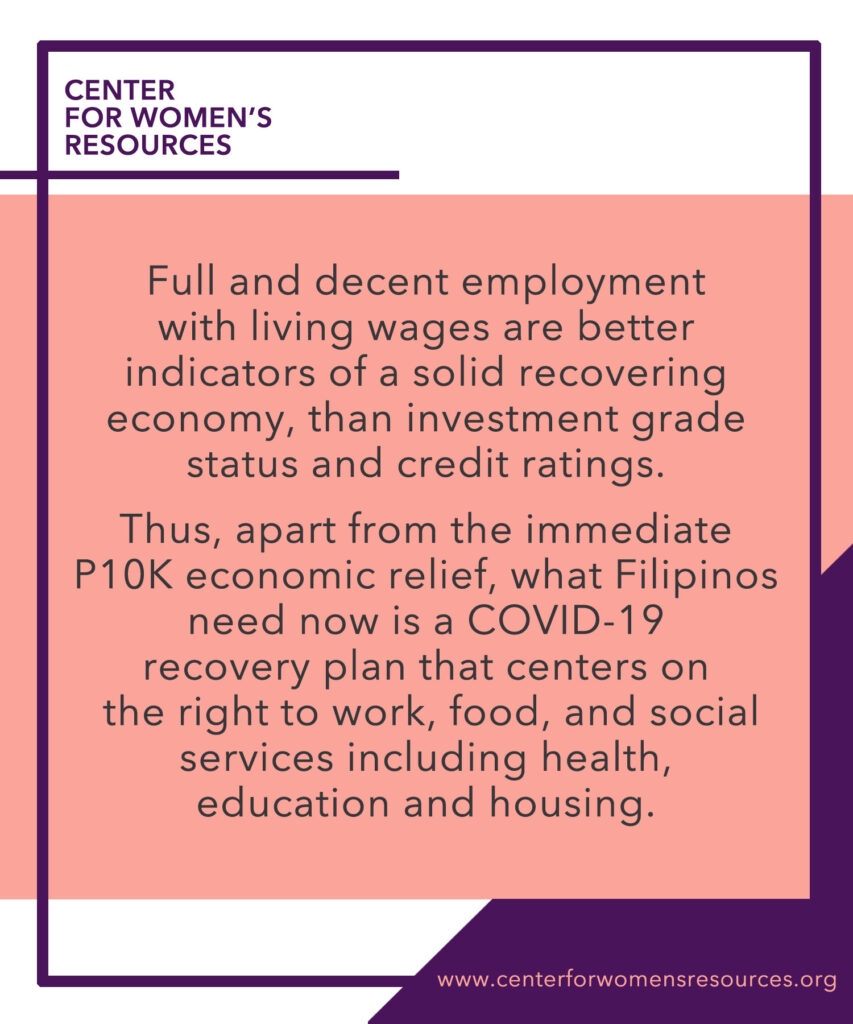
The longest military lockdown resulted in the biggest annual economic contraction since 1947 at 9.5% (2020), exceeding the economic plunge brought by the Marcos dictatorship, as well as the Asian and global financial crises. Remittances from overseas Filipino workers (OFW), which keeps the bankrupt economy afloat, decreased by 0.9% compared to that of 2019.
The number of virus infections continue to grow alongside the numerous human rights violations committed by law enforcers themselves. At present, the administration spreads fear by displaying armed military and police personnel, legitimized through Memorandum Order No. 32, Whole-of-Nation approach (Executive Order No. 70) and the Anti-Terrorism Law (ATL). The anger that the administration only strengthened the collective power of the Filipino people and the women’s movement.
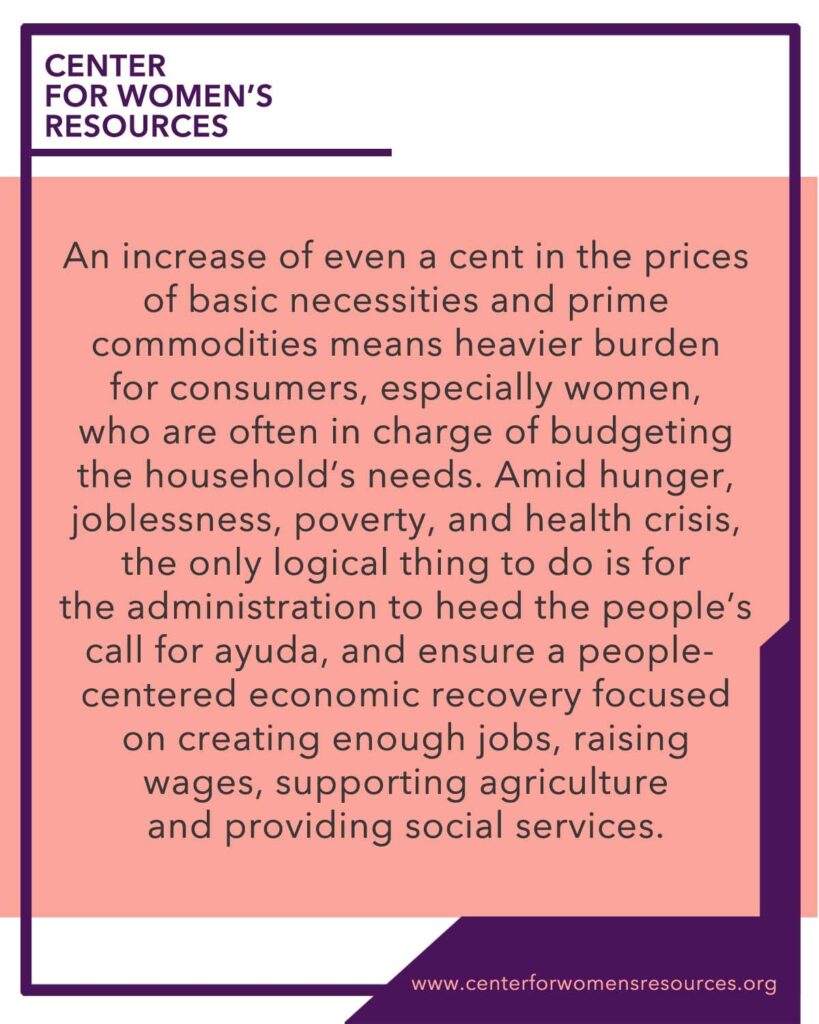
Not long after the declaration of the nationwide community quarantine, workers began finding themselves robbed of their sources of living. According to the Philippine Economic Zone Authority (PEZA), more or less 700 factories of car parts, electronics, industrial, and consumer goods in Luzon temporarily closed. Shopping malls and restaurants ceased regular operations as well. About 400,000 drivers lost their jobs after banning public transportation. This sudden shutdown of companies and establishments left 7.2 million individuals jobless, 2.4 million of them are women, in the middle of a pandemic with little to no aid received from the national government. Filipinos barely survived through meager government relief and initiatives done by fellow citizens, people’s organizations, and NGOS; jeepney drivers begged for food in the streets, women shifted to online selling and other means to earn and provide for their families.
Various schemes were done by factories and large companies in attempts to avoid their responsibilities to their workers. Many women workers are still in a “floating status” with no assurance and information on their job status. Factories producing essential goods continued their operations but did not provide transportation for their laborers who were then forced to walk for hours to and from work. Shifts became “rotational”, and many workers did not receive overtime pay. In some companies, 12 hours of work was compensated with Php300-Php600 per day. The implementation of strict health protocols became an added burden to the working force as they had to pay for their own swab tests and medical clearances due to the absence of mass testing. Those with COVID-19 symptoms were asked to observe a 14-day quarantine that was counted as “no work, no pay.”
Contractual laborers do not have benefits, and thus no economic nor health protection from their employers during this pandemic. For those who were allowed to work from home, electricity and internet bills were shouldered by the workers, resulting in additional costs to their household’s meager budget. The inability of the labor force to keep up with the health crisis and increasing costs of basic needs is met with the campaign of Php100 immediate wage relief to help the working class survive through the pandemic.
Even before the pandemic, the health services of the Philippines were inadequate due to the limited state funding and support. One of the most impacted are health workers, seven out of which are women, who were exploited through low wages and poor working conditions. Majority of hospitals remained under private ownership. During the first few months of the pandemic, there were already calls for strict and efficient contact tracing, and use of medical solutions to fight the virus before it became uncontrollable. The lack of clear and proper information dissemination resulted to discrimination experienced by health workers in their various communities, thought as carriers of the virus. Private hospitals were exposed selling donated PPEs to their health workers. After almost a year of the nationwide lockdown, about 14,000 health workers tested positive with COVID-19.
Filipino farmers are considered as the “food security frontliners” of the country but they remain as the most neglected sector, experiencing grave hunger and poverty. Still unable to recover from the eruption of the Taal volcano in January, farmers attempting to find work in surrounding cities were faced with a new problem having imposed the Enhanced Community Quarantine in Luzon. This brought a halt to the planting and harvesting in the agricultural sector. Checkpoints hindered agricultural products from arriving to markets in the urban areas. Tons of goods were left to rot, farmers and fisherfolk fell deeper into debt. The pandemic was especially difficult for women farmers and their families, who did not have their own land. In 2020, the total agricultural output of the country fell by 3.8%. Meanwhile the price of pork reached its highest within two years. According to the Bureau of Agricultural Statistics the price of rice fell upon the implementation of the Rice Liberalization Law. In 2020, the average price of local rice was Php18.78 per kilo. Vegetable farmers decided to not continue the production of vegetables due to the cost of transporting their goods to trading centers.
Despite the numerous shutdowns, harassment and deception towards the indigenous people (IPs) and the violation of their rights persisted. Limited information regarding the virus reached their communities. Due to development aggression and land use conversion, Lumads were forced into construction work and various jobs to afford food. Not all IPs received emergency relief from the national government; majority of the aid they received were initiatives from NGOs and CSOs. Indigenous women continue to be impacted by development aggression projects. At present, 276 mining claims and 124 energy projects are approved in the Cordillera Administrative Region. Non-stop quarrying, mining and deforestation continue to damage the country’s natural defense as seen in the effects of the recent typhoons in Bicol, Quezon, Cagayan, Rizal, at Surigao del Sur.
Women working in the informal sector — owners of sari-sari stores and food stalls, manicurists and pedicurists, domestic workers, are also impacted with the loss of their livelihood due to quarantine restrictions. Unlike those in the formal sector, self-employed women are usually not covered by labor regulations and social protection. It was recorded in April 2020 that 2.6 million lost their jobs in the informal sector, many of whom are women. Under the guidelines of the social amelioration program, said workers are to receive a Php5,000-Php8,000 cash subsidy but according to the interviewees, many only received SAP once or some not at all. Issues hound the implementation of the program — names missing in the list, issues in identifying qualified recipients, discrimination when only one in each indentified household or roof can receive even oif two or more families are residing in such household. On the other hand, the Tulong Panghanapbuhay sa Ating Disadvantaged/Displaced Workers (TUPAD) program was allocated only Php20 billion, almost the same amount devoted to the NTF-ELCAC.
More than half of Filipino migrants are women, concentrated in low paying jobs with high risk of abuse. More than 400,000 OFWs returned to the Philippines since the beginning of the pandemic. Aside from the increased working time of domestic helpers, they were also robbed of their weekly day-off. Expenses for purchasing facemasks and alcohol are also shouldered by the migrant workers. Many did not receive any aid from their host country nor the Philippine government. This affected the Filipino families that greatly depended on the earnings of their OFWs. To add, according to the report of the Department of Foreign Affairs, the number of OFWs who tested positive for the virus reached 14,389 cases and 954 deaths (February 2021).
While the country suffers in a deep economic crisis, human rights violations remain rampant. The Center for Women’s Resources recorded the arrest of at least 54 women human rights defenders, activists, farmers and youth from January 2020 until February 2021. It was also noted that eight women human rights defenders were killed last year, including teacher, paralegal and human rights advocate Zara Alvarez. The militarist lockdown was used as a front to continue the red-tagging of individuals and organizations by the state, harass farmers, and abuse indigenous people. This administration’s hands are stained with the blood of two newborns, children of political prisoners and mothers Nona Espinosa and Reina Mae Nasino. The regime’s fear of women is made apparent through the disqualification case against Gabriela Women’s Party and terror-tagging of the Makabayan bloc by the NTF-ELCAC. Journalists from alternative media sources are also attacked for reporting truths. Said arrests include Lady Ann Salem, arrested on Human Rights Day, and Kimberlie Quitaso from and Khim Russel Abalos from Northern Dispatch charged with cyberlibel for an article on the Chico River Dam heroes’ monument. Last February 15, AFP-PNP raided a retreat house of Societas Verbi Divini (SVD) Philippines Southern Province in the University of San Carlos (USC) in Cebu city. The “rescue mission” was an illegal arrest of two volunteer teachers and students of legal age with trumped up charges. Lumad Bakwit Schools are products of the militarization, destruction and bombing of schools in Mindanao ordered by the Duterte administration. Youth Lumad only aim to continue their right to education and take part in the development of their tribes.
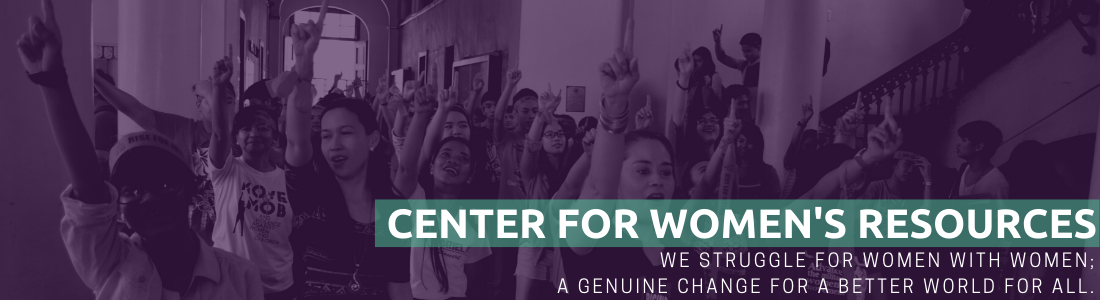
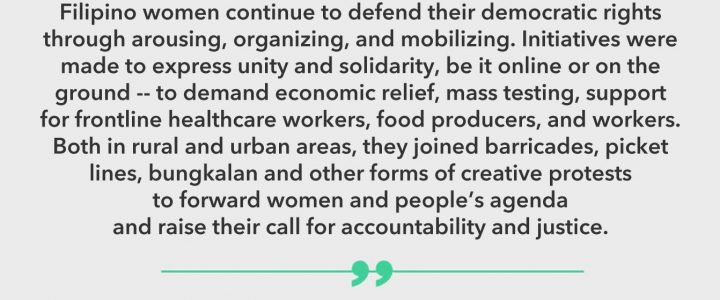
While the efforts of the administration are focused on suppressing and silencing expression and resistance, Filipino women continue to defend their democratic rights through arousing, organizing, and mobilizing. Initiatives were made to express unity and solidarity, be it online or on the ground — to demand economic relief, mass testing, support for frontline healthcare workers, food producers, and workers. Both in rural and urban areas, they joined barricades, picket lines, bungkalan and other forms of creative protests to forward women and people’s agenda and raise their call for accountability and justice. Extreme hunger, violence, and poverty push oppressed women to join arms with the basic sectors to forge a new system that genuinely serves the people.
Indeed, for women, solidarity and a change in the broken system of neoliberalism are the only antidotes to COVID19 and lockdown.#