𝙒𝙝𝙮 𝙧𝙚𝙘𝙡𝙖𝙞𝙢𝙞𝙣𝙜 𝙙𝙞𝙜𝙞𝙩𝙖𝙡 𝙘𝙞𝙫𝙞𝙘 𝙨𝙥𝙖𝙘𝙚 𝙢𝙖𝙩𝙩𝙚𝙧𝙨?

Digital platforms have become important spaces for organizing, advocacy, and civic participation. For young people, women, and marginalized communities, they provide opportunities to raise concerns, connect with others, and participate in public discussions and collective action. But digital spaces are also increasingly being used to silence dissent.

In the Philippines, community organizers, young women leaders, and advocates from workers’, farmers’, urban poor, and other marginalized sectors face tech-facilitated violence and repression —including online harassment, surveillance, misinformation and disinformation, coordinated trolling, and red-tagging. These attacks do not only happen online; they create fear, encourage self-censorship, disrupt organizing, and limit people’s ability to safely participate in civic and democratic processes. Women, youth, and marginalized sectors already face structural barriers to participation. When their voices are attacked, discredited, or silenced online, these barriers become even greater.

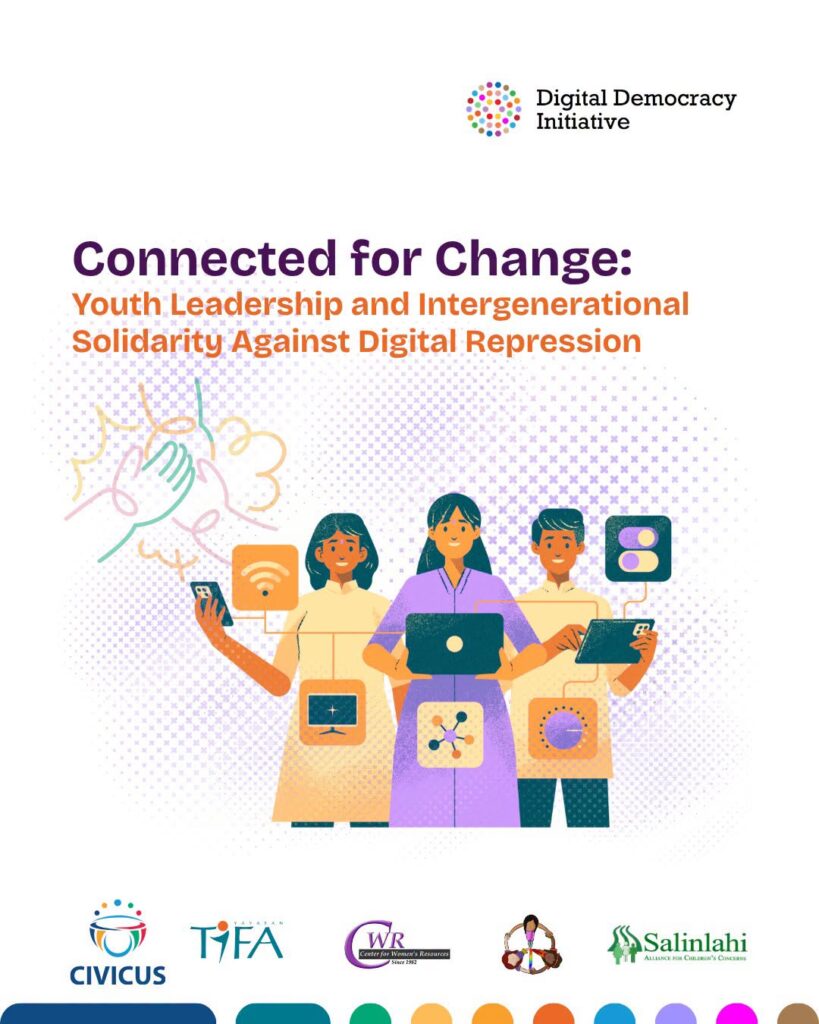
In October 2026, through the “Connected for Change: Youth Leadership and Intergenerational Solidarity Against Tech-Facilitated Violence and Repression”, the Center for Women’s Resources (CWR), Girls for Peace, and Salinlahi Youth seek to strengthen young women leaders’ capacity to understand, analyze, and respond to these challenges through safer and more strategic digital civic engagement. It will also create a space for intergenerational dialogue and collaboration with experienced organizers from workers’, farmers’, and urban poor communities. Together, we aim to strengthen solidarity, develop collective advocacy initiatives, and build sustained action against digital repression and shrinking civic space. This project is supported by the Tifa Foundation and Civicus Alliance thru the Digital Democracy Initiative.

Digital spaces should be spaces for participation, organizing, and collective action, not fear and intimidation. Together, we can reclaim our digital civic space and use it to create change.

The Center for Women’s Resources was selected as a grantee by Tifa Foundation and CIVICUS’ Digital Democracy Initiative under the Re-D Fund Cohort 2.

Under the project “Connected for Change: Youth Leadership and Intergenerational Solidarity Against Digital Repression” CWR with Girls for Peace and Salinlahi Youth will conduct a training on digital civic engagement and mass campaigning which aims to strengthen young women leaders’ capacity to effectively and strategically use digital civic spaces for information dissemination, public education, organizing, mass campaigning, and advocacy.

#DDI_EastSEA #ReclaimCivicSpace #DefendFilipinoWomen

PH Government’s Poverty Rate Does Not Reflect Filipinos’ Economic Realities – CWR

The Center for Women’s Resources (CWR)* cautioned the Marcos administration against presenting the reported decline in official poverty incidence as proof that Filipino families are now living better, saying that statistical improvement does not automatically translate into economic security, decent work, or a life of dignity.

The Philippine Statistics Authority (PSA) reported that the proportion of Filipinos classified as poor fell from 15.5 percent in 2023 to 9.7 percent in 2025 – equivalent to a decline from approximately 17.5 million to 11.1 million people. The government has described the figures as significant progress in poverty reduction.

CWR, however, said that the government’s poverty figures represent a serious distortion of the actual extent and depth of poverty in the Philippines. By relying on a poverty threshold that does not adequately reflect the real cost of living or the income required for families to meet their basic needs and live with dignity, the government effectively narrows the definition of who is considered poor. This makes poverty appear smaller on paper than it is in people’s everyday lives. 

Millions of Filipinos who continue to struggle to afford adequate food, housing, healthcare, education, transportation and other basic necessities may be classified as non-poor because their income falls slightly higher above the official poverty threshold. In this sense, the government’s poverty statistics can obscure rather than illuminate the extent of economic hardship experienced by Filipino families. 

For CWR, the Marcos administration is using this statistical framework to create the impression that its poverty reduction program is effective, when the underlying economic conditions that produce poverty remain largely unchanged. 

“The government is celebrating how many people have crossed the poverty line, but it is not asking the more important question: What kind of life can a Filipino family actually afford after crossing that line?” said CWR Executive Director Cham Perez.

“The problem is not simply that millions are classified as poor. Millions more remain economically insecure – struggling to afford food, housing, healthcare, education, transportation, and other basic needs – yet are no longer counted as poor under the government’s narrow and conservative statistical definition,” Perez added.

A poverty line too low to live on

The inadequacy of the government’s poverty measure becomes clearer when the official poverty threshold is compared with the actual costs of meeting a family’s basic needs. 

The 2025 annual per-capita poverty threshold was P35,121, or approximately P96.22 per person per day, according to figures cited by the IBON Foundation. For a family of five, this translates  to only around P14,634 per month.

Under this standard, a family earning even slightly above the threshold may be officially classified as non-poor despite struggling to pay for food, rent, electricity, transportation, education, healthcare, and other necessities.

CWR said the situation exposes the gap between being technically above the poverty threshold and being able to live a decent and secure life.

The gap becomes even more stark when the official poverty threshold is compared with what families actually need to meet their basic requirements. As of July 2026, a family of five needs a living wage of P1,277 per day, while a family of six needs P1,533 per day. The average minimum wage nationwide, meanwhile, is only P512 per day.

A minimum-wage worker earning the national average therefore receives only about 40 percent of what a family of five needs and roughly one-third of what a family of six needs.

“For millions of Filipino workers, the issue is not whether they are technically above the poverty line. The issue is whether their wages can actually sustain their families,” Perez said.

“An income that places a family just above an extremely low poverty threshold cannot be presented as proof of economic well-being. If a worker must work longer hours, take on additional jobs, borrow money, or depend on government assistance just to put food on the table and pay for basic services, then poverty and economic insecurity remain very real,” she added.

Women remain economically insecure

For CWR, the government’s poverty narrative also obscures the particular economic conditions faced by Filipino women, many of whom remain excluded from stable, adequately paid, and protected employment.

Having a job does not necessarily mean having economic security. Many are concentrated in vulnerable and informal work– including vending, home-based work, domestic work, and gig work—where workers may lack stable employment, adequate wages, benefits, and social protection.

CWR estimates that more than 20 million women face economic insecurity because of insufficient income, limited livelihood and employment opportunities, and job insecurity.

The shortage of decent and sufficient employment is also reflected in official labor statistics. As of June 2026, at least 2.59 million Filipinos were unemployed, up from 1.95 million in June 2025. Another 6.11 million were underemployed – already working but seeking additional hours, additional work, or a new job with longer hours.

CWR said these figures demonstrate why employment rates alone cannot be used as evidence of economic well-being.

“Having a job is not synonymous with having a decent livelihood,” Perez said. “A person working only a few hours, a worker seeking more hours because current income is insufficient, or a woman forced into precarious informal work cannot simply be counted as evidence that poverty is being resolved.”

High self-rated poverty

CWR also pointed to the difference between official poverty figures and people’s own assessment of their economic condition. A Social Weather Stations (SWS) survey released in January 2026 found that 51 percent of Filipino families, or approximately 14.3 million families, considered themselves poor.

CWR emphasized that the SWS self-rated poverty measure and the PSA’s official poverty measure use different methodologies and should not be treated as directly comparable statistics. Nevertheless, the contrast highlights the limits of relying on a single income threshold to understand how Filipino families experience poverty and economic insecurity.

“Statistics are important, but they should illuminate people’s realities rather than conceal them,” Perez said. “When millions of families continue to feel poor and economically insecure despite being counted as above the official poverty line, the government must examine what its poverty measure is failing to capture.”

Measure progress by people’s lives

For CWR, genuine poverty reduction requires confronting the structural conditions that produce and reproduce poverty – particularly the country’s lack of national industrialization and its backward agricultural economy, which continue to limit the availability of stable and decent-paying jobs.

“Poverty cannot be solved by simply moving people from one side of a statistical line to the other,” Perez noted. “The government’s measure of success should not be how many Filipinos are no longer counted as poor, but how many families can actually afford nutritious food, decent housing, quality education and healthcare, secure livelihoods, and a life free from constant economic anxiety.”

“Filipino women deserve more than being statistically classified as non-poor. They deserve decent work, adequate incomes, accessible public services, social protection, and the conditions to live with dignity and security,” Perez concluded.

*The Center for Women’s Resources is a Philippine non-profit women’s organization that conducts research, education, and advocacy on issues affecting women and marginalized communities.
Justice for “Comfort Women” and All Victims of Military Sexual Violence! Stop Financing Militarism and War! End Military Spending That Fuels Violence Against Women!

The Center for Women’s Resources (CWR) joins women and peoples around the world in a global day of action to remember the victims and survivors of war and in demanding justice for “comfort women”. The Japanese Imperial Army’s “comfort women” system remains one of the clearest examples of state-sanctioned military sexual slavery. Yet even more than 80 years after the end of World War II, survivors in the Philippines and across Asia continue to await genuine justice, including an official apology, reparations, and recognition of their history.

CWR condemns Japan’s continuing historical revisionism and its growing remilitarization, including its expanding military cooperation with the Philippines through the Philippine-Japanese Reciprocal Access Agreement. The strengthening of military alliances and foreign military access must not come at the expense of women’s rights, community safety, and national sovereignty.

Militarization does not bring genuine security for women and communities. Instead, it deepens violence, displacement, and insecurity. The legacy of military sexual violence in the Philippines stretches from the abuses committed by the Japanese Imperial Army during World War II, to the documented history of violence surrounding US military bases, and to present-day reports of cases of displacement, harassment, exploitation, and sexual violence in militarized communities. Across these periods, women have borne a disproportionate share of the social and economic costs of militarization.

The Philippine government’s continued increase in military spending, alongside agreements and financing arrangements that expand the presence and access of foreign militaries, raises serious concerns about the safety and welfare of Filipino women and their communities. Militarization diverts public resources away from essential social services while creating environments where women and other vulnerable sectors may face heightened risks of abuse and exploitation.

Last year, the United States government approved a $2.5 billion Foreign Military Financing (FMF) grant package for the Philippines covering fiscal years 2026 to 2030, amounting to roughly $500 million annually. At the same time, the Marcos Jr. administration is alloting ₱452.4 billion for military spending in 2027, a 6.8% increase from the previous year’s military budget. CWR calls into question how these massive allocations for military expansion will further affect communities already facing poverty, displacement, and insecurity, and warns that increased militarization can further expose women to harassment, trafficking, sexual violence, and other forms of abuse.

The commemoration of the victims and survivors of World War II must not be reduced to remembering the past while ignoring the conditions that continue to enable military violence against women today. The experiences of “comfort women” survivors remind us that women’s bodies have repeatedly been treated as instruments of war and militarization.

CWR calls for an end to militarization, imperialist wars, and all forms of military sexual violence. We demand justice for the comfort women and accountability from states responsible for wartime and military sexual violence, including meaningful reparations, official recognition, and guarantees that such abuses will not be repeated.

We reject the use of women’s bodies and communities as collateral in military alliances and war economies. Public funds must serve the people, not the expansion of military power and foreign military interests. Genuine peace requires social justice, women’s rights, accountability, and respect for national sovereignty, not ever-increasing military budgets and foreign military presence. #

Marcos Jr. administration weaponizes criminal charges against labor organizers – CWR

Marcos Jr. administration weaponizes criminal charges against labor organizers – CWR

The Center for Women’s Resources (CWR), a women’s research institution, condemned the issuance of arrest warrants against veteran child rights advocate and women labor organizer Jacqueline “Jacq” Ruiz of the Kilusan ng Manggagawang Kababaihan (KMK or Women Workers’ Movement) and Kilusang Mayo Uno (KMU or May First Movement) Chairperson Jerome Adonis.

“These charges are an attack on workers’ rights and the democratic right to protest,” said CWR Executive Director Cham Perez. 

According to reports, the arrest warrants were issued by the Metropolitan Trial Court (MTC) Branch 28 in connection with a workers’ rights protest on May 1, 2026. Both Ruiz and Adonis are being charged under Article 153 of the Revised Penal Code for alleged tumults and disturbances of public order. 

For CWR, the charges are part of a continuing pattern of criminalization directed at workers and organizers who exercise their rights to organize, assemble, and protest.

“Instead of listening to workers’ demands for decent living wages, secure employment, and better working conditions, the government is choosing to criminalize those who raise these demands,” Perez said. “The use of criminal charges against labor leaders is a dangerous form of repression that seeks to intimidate not only the individuals being targeted, but also the broader labor movement,” Perez added.

CWR stressed that Ruiz’s case also highlights the need to safeguard women’s engagement in labor and community organizing. Women workers share the same forms of exploitation that workers face in general – low wages, insecure employment, and violations of labor rights.  At the same time, they carry a disproportionate share of domestic work. Women’s organizations and women workers’ formations have thus played a significant role in raising these issues in public debate and collective action.

“Targeting women labor organizers does not only threaten their personal safety and security. It also undermines women’s capacity to collectively assert their rights in the workplace, in their communities, and in society,” Perez noted.

CWR emphasized that Ruiz’s decades of advocating for children’s and women’s rights and the well-being of vulnerable communities, as well as her organizing for workers’ rights, should not be used as grounds for criminalizing her advocacy.

Criminalization amid ongoing human rights violations

The arrest warrants must also be viewed within the broader context of the continuing human rights violations under the Marcos Jr. administration.

According to human rights group Karapatan, over 11 million people had been victims of various human rights violations from July 2022 to June 2026.  It documented 147 cases of extrajudicial killing, 16 cases of enforced disappearance, 892 cases of arbitrary arrest, and 580 cases of forced or fake surrender,  alongside thousands of incidents of indiscriminate firing and bombing since July 2022. Millions were likewise affected by forced evacuations, threats, harassment, intimidation, and red-tagging.

For CWR, the criminalization of labor organizers needs to be seen in this broader pattern of repression. 

“Criminalizing protest is a way of silencing protest,” said Perez. “When workers are threatened with arrest for simply demanding a decent living wage, secure employment and their rights at work, the government is not dealing with the problems that cause people to protest in the first place. It is just an attack on those who expose them,” Perez added.

CWR noted that the rights to peaceful assembly, freedom of expression, and freedom of association are fundamental democratic rights.  Labor organizing and collective action are also protected under Philippine law and international human rights standards – to organize is not a crime, but a right. The organization urged the courts and concerned government agencies to junk the charges against Ruiz and Adonis and to stop using criminal cases to intimidate labor and human rights defenders.

Address workers’ demands, not suppress them

CWR called on the government to meet the legitimate economic needs of workers, instead of suppressing those who raise them. 

“The government must stop treating workers’ demands as a threat to public order,” Perez said. “The real threat is a system that leaves millions struggling with low wages, insecure jobs, rising cost of living, and declining living conditions while those who challenge these conditions are harassed, intimidated, and criminalized. The criminalization of labor leaders and advocates does not address the conditions that drive the workers to protest. Instead, it suppresses the voices that call attention to these injustices,” Perez concluded. 

CWR expressed solidarity with Ruiz, Adonis, and other workers and organizers facing criminalization, and called on the public to defend the right of workers and women organizers to organize, protest, and speak out without fear of reprisal.

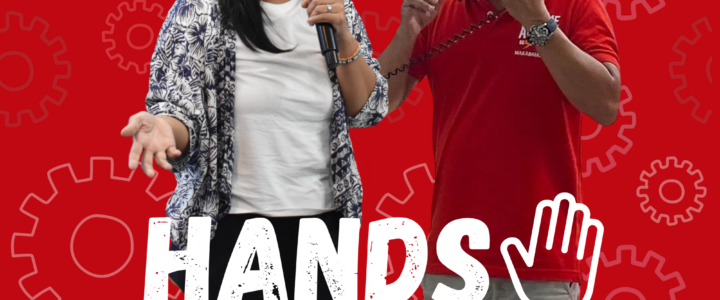
Hands Off Jacq Ruiz! Defend the Right to Organize and Protest!

The Center for Women’s Resources (CWR) expresses its solidarity with veteran child rights advocate and woman labor organizer Jacqueline “Jacq” Ruiz of the Kilusan ng Manggagawang Kababaihan (KMK or Women Workers’ Movement) and Jerome Adonis, Chairperson of Kilusang Mayo Uno (KMU or May First Movement), following the issuance of warrants of arrest against them in connection with a workers’ rights protest on May 1, 2026.

We reaffirm that the rights to peaceful assembly, freedom of expression, and freedom of association are fundamental democratic rights. The right of workers to organize, collectively bargain and engage in peaceful collective action are protected under Philippine law and international human rights standards.

The filing of charges under Article 153 of the Philippine Revised Penal Code in relation to alleged public disturbances, is deeply concerning.  The use of criminal charges against workers and their advocates for exercising their legitimate democratic rights constitutes judicial harassment and contributes to the broader criminalization of labor organizing, protest, and dissent. 

Workers’ demands for decent wages, secure employment, safe workplaces and dignified working conditions are not threats to public order. They are legitimate demands rooted in the basic rights and aspirations of working people. Peaceful protest is not a crime, and raising one’s voice against unjust conditions should never be grounds for persecution. 

What truly threatens the welfare and security of working people is a system that continues to leave millions struggling with low wages, precarious employment, rising costs of living  and declining living conditions– while those who challenge these conditions are harassed, intimidated and criminalized. The criminalization of labor leaders and advocates does not address the conditions that drive the workers to protest. Instead, it suppresses the voices that call attention to these injustices. 

We are particularly concerned by the targeting of Jacq as a woman labor organizer. Women workers experience exploitation and violations of their labor rights while continuing to shoulder a disproportionate share of care responsibilities. Women’s organizations and women workers’ groups play a vital role in organizing communities, asserting labor rights, and challenging the conditions that perpetuate inequality in workplaces, communities , and society. 

The criminalization of women organizers carries a distinct and gendered impact. It threatens not only their safety, security,  and freedom, but also creates a chilling effect on women’s participation in collective action. Jacq’s decades of advocacy for children’s and women’s rights, as well as her organizing for workers and vulnerable communities, should never be weaponized against her. Her long-standing commitment to defending the rights of others is not a crime. 

It is deeply unbecoming of a government that presents itself as a champion of women’s rights and labor rights to respond to women workers and labor organizers with harassment, criminalization, and judicial persecution. The treatment of Jacq, Jerome, and other labor organizers exposes the widening gap between the government’s rhetoric and its actions. 

More seriously, these actions expose the government’s increasingly repressive and authoritarian approach to dissent. A government that claims to uphold women’s and workers’ rights must protect those who exercise these rights—not punish them.  

CWR stands firmly with Jacq, Jerome, and all workers and organizers facing harassment and persecution for exercising their fundamental rights. We demand the immediate withdrawal of the charges against them and an end to the judicial harassment of labor leaders, activists, and human rights defenders in the Philippines.

We call on our networks, allies, and human rights organizations to stand in solidarity with Jacq, Jerome, and all workers and organizers facing criminalization for defending their rights. #