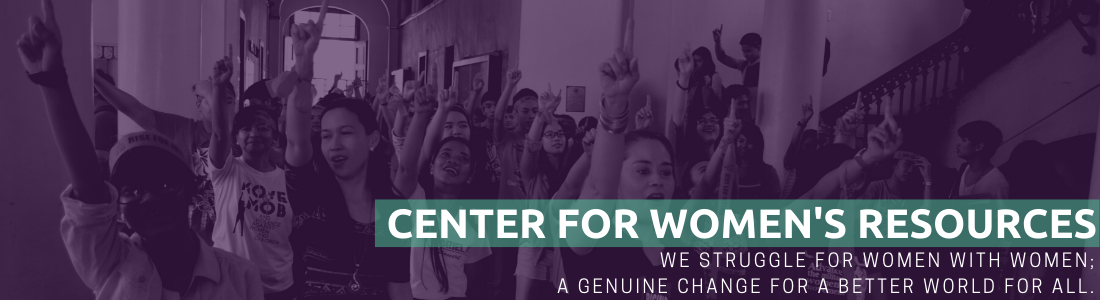
The Center for Women’s Resources raises concern against another police-perpetrated rape of a female rider in a checkpoint in Mabalacat, Pampanga on October 8.
Police-perpetrated violence against women has been a systemic issue, despite promises of reforms in the PNP. CWR records at least seven reported cases of state-perpetrated violence against women since the beginning of the pandemic in March 2020 to the present, including the rape-slay of a minor by two policemen in Ilocos Sur last year, and at least two cases of police-perpetrated rape against women who have been apprehended for violating quarantine measures. There have also been reports of “sex-for-pass” especially during the enhanced community quarantine. Men in uniform have abused the strict implementation of lockdowns to further violate women’s rights.
CWR also notes that there have been 56 police officers who have been involved in 33 cases of abuse against women, including 16 cases of rape during the first two years of Pres. Duterte in office, from July 2016 to March 2018.
Pres. Duterte with his long list of disparaging remarks against women, blatantly enables perpetrators to commit violence against women. He himself has repeatedly and proudly violated women, and has never shown remorse in doing so.
CWR expresses utmost support in the passage of the amendments of the Anti-Rape Law. Higher penalties need to be imposed on perpetrators who gravely abuse their power and commit such heinous crimes.
Women and children who are victims of violence have suffered too much, with the delays in the pursuit of justice, much more when perpetrators are in uniform. We must remain vigilant in holding perpetrators accountable and ensuring that those who continue to support such acts be removed from power. #
Statements and Media Releases
Statements and media releases and statements from the Center for Women’s Resources
On the Recent Price Hikes
The Center for Women’s Resources (CWR) raises alarm on the rising prices of commodities, signifying additional burden for Filipinos who are struggling everyday to survive amid joblessness and rising COVID-19 cases in the country.
The country’s inflation rate has almost doubled since the onset of the pandemic, from 2.5% in March 2020 to 4.9% in August 2020, its highest since the 5.1% inflation rate in December 2018.
Prices of basic commodities have increased during the pandemic. Rice prices rose to at least Php 3.00 per kilo, belying the claims of the proponents of the Rice Liberalization Law that it will significantly lower the domestic price of rice. On the other hand, poultry products such as beef and pork rose to as high as 50% during the pandemic.
Vegetables, fruits, and other basic commodities are also increasing. In addition, the Department of Trade and Industry has approved a 3-5% price hike resulting in an increase of as high as Php 2.25 for basic commodities such as milk, noodles, sardines, and canned meat.
Liquefied Petroleum Gas (LPG) is at Php 607.00 for every 11-kilo container in April 2020 to Php 891.00 in August 2021. Oil prices have also increased at least Php 7.00-12.00 in the last year and a half.
Tess Arboleda, an urban poor community leader from Quezon City, laments the detrimental impacts of rising prices of basic needs.
“Sa patuloy na pagtaas ng presyo ng bilihin pinapatay kaming mga mahihirap. Sa pananatiling walang pakialam ang gobyerno sa pagtaas ng presyo ng bilihin ay patunay lang na walang halaga at kawalan ng malasakit sa aming mga mahihirap na lalo pang nilulugmok sa kahirapan,” she said.
Meanwhile, minimum daily wage in the National Capital Region, the highest in the country, has been nailed at Php 537 in the last three years. The last wage hike is a meager Php 25 in November 2018. The current minimum wage will barely allow a family to survive amid rising prices of commodities, additional expenses for transport, education, and health needs especially in the pandemic. IBON Foundation computed the family living wage at Php 1065 per day in July 2021. Mothers are also concerned about the opening of classes for the coming school year, saying that they would have to find means to support expenses for their children’s online classes.
“Sa haba ng pandemya at lockdown dito, lockdown doon, hindi na natapos, maraming di- tiyak ang trabaho ng mga asawa. Kulang pa ang kikitain sa pang-araw-araw na gastos. Tapos sa pagbubukas ng klase kung online na naman, saan uli kukunin yung mga dagdag na gastusin sa pag-aaral ng mga anak,” says Liza Maynigo from Marikina City.
Moreover, the unemployment rate hit an all-time high of 17.7% during the first month of lockdown in April 2021. In addition, CWR initially estimated that in 2020, at least 19.54 million women are economically insecure. In situations like these, women, especially mothers, are forced to seek alternative sources of income to augment family income.
“Despite the worsening economic crisis, the current administration would rather bury itself in ensuring profits for questionable foreign businesses, taunting critics, and implementing roulette-like lockdown classifications to supposedly respond to the COVID-19 while more and more Filipinos are neck-deep in hunger and poverty,” says Cham Perez, CWR Executive Director
We reiterate our demand to the government to immediately provide economic relief for those who have lost their jobs and livelihood during the pandemic, and ensure regulation of prices of basic commodities in addition to mass testing, proper contact tracing and increasing vaccination rates to effectively respond to the COVID-19 pandemic. #
On the rising debt
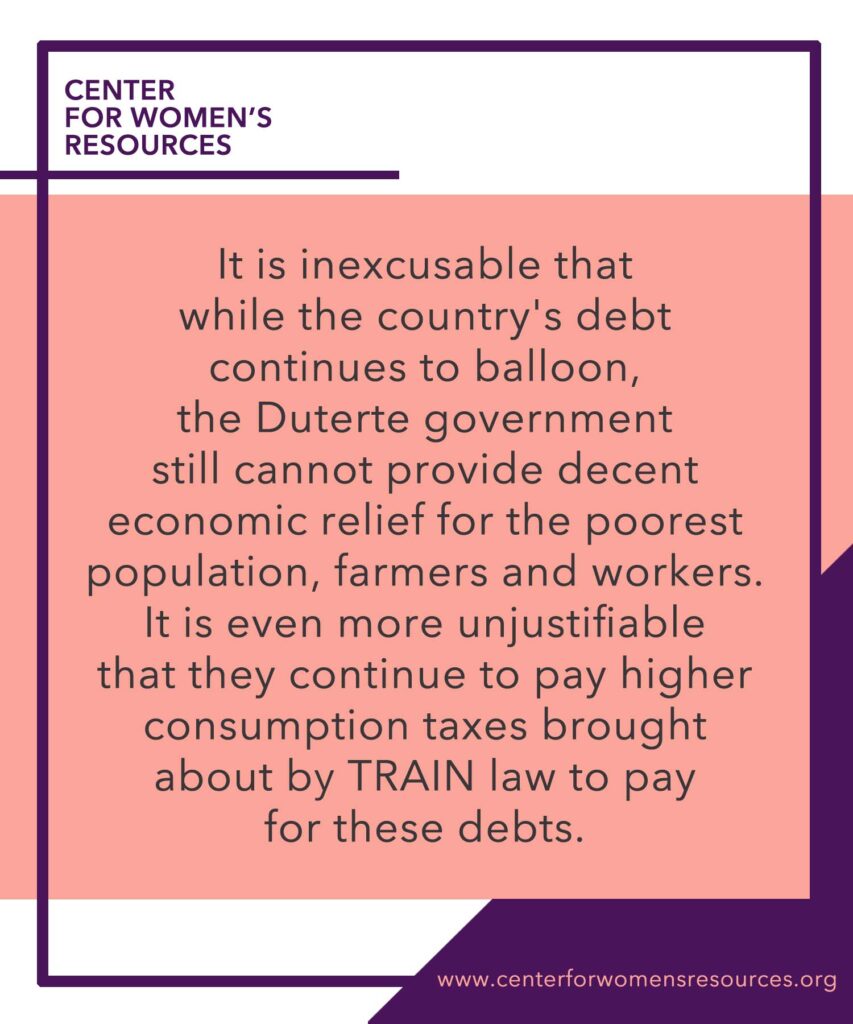
As the Philippine government’s total outstanding debt rises up to P11.166 trillion, 23.3% higher than in the same period a year ago, it is inexcusable that the Duterte government still cannot provide decent economic relief for the poorest population, farmers and workers.
This is despite the record-breaking borrowings in 2020 supposedly to fight the health and socioeconomic crises due to COVID-19 pandemic.People’s organizations have been calling for Php10,000 economic assistance for poor families, Php100 emergency wage relief for workers, and Php15,000 production subsidy for farmers whose work and livelihood have been greatly impacted by the pandemic lockdowns.On the other hand, poor Filipinos, including women, carry the burden of paying higher consumption taxes due to the TRAIN law passed in 2017 to fund the government’s BBB infrastructure program, as well as payments for trillions of incurred debts.
CWR STATEMENT on the harassment and mistreatment of peaceful protesters at the DILG yesterday, July 16
We are alarmed with how a certain Noel Dumalag of the Emergency Operations Command of the Department of Interior and Local Government (DILG) shoved, harassed, and mistreated a number of women, among which are mothers, wives, and relatives of the victims of the Duterte administration’s bloody drug war, during a peaceful protest at the DILG yesterday, July 16.
The Center for Women’s Resources (CWR) urges the DILG and other government institutions to be responsible for such incidents and penalize Dumalag and other violators for possible violations of RA 11313 or the Safe Spaces Act. While enraging, this is not the first time women have experienced abuses while exercising their civil rights, especially from state agents who are expected to ensure their safety and protection.
Cases of violence against women by state perpetrators continue to increase.At least 61 arrests of women human rights defenders have been recorded since the beginning of the lockdown last March 2020 to the present. Moreover, at least 68 VAWC cases committed by police officers since July 2016 were monitored by CWR. In addition, the research institution has recorded at least 62 extra-judicial killings of women human rights defenders since Duterte came into power.
We continue to call out the Duterte administration for its failed drug war that has widowed and orphaned thousands of women and children, and for allowing and encouraging violence and misogyny to perpetuate.We urge our fellow sisters, wives, and mothers to speak out against all forms of harassment, and to continue to struggle unwaveringly for emancipation and justice.
Watch Video Link: https://www.facebook.com/watch/live/?v=366698628128896&ref=watch_permalink
‘Food security frontliners’ remain hungry, bound to exploitative relations of production – CWR
More than a year into the COVID-19 pandemic, farmers and farm workers remain the most neglected and hungry despite being considered as “food security frontliners.” Farm workers, especially, continue to suffer dire poverty and feudal and semi-feudal exploitation due to landlessness, agricultural backwardness and rural maldevelopment.
In the town of Guimba, Nueva Ecija, Radyo Natin Guimba (2021) reported an increase in upa sa tanim or contractual payment for rice grain planting to Php5,000 per hectare from the previous amount of Php4,500 per hectare for high breed seeds such as SL8 and Longping palay varieties during the rainy season cropping period. Moreover, there are also “package deals” of land preparation and planting called bunot-tanim which costs Php 7,000. In addition, contractual payments for inbred seeds amounts to P6,500 per hectare for “package deals”. Upa sa tanim also varies in different regions and provinces.
However, while there is a slight increase in upa sa tanim, this does not automatically translate to higher daily wages for farm workers. This contractual payment for planting is usually managed by the kabesilya or middlemen who typically, employs around fifteen (15) farm workers who work on a hectare of land for the entire day. After the kabesilya has deducted a significant share of the payment for their management, as well as the farm workers’ tampa, farm workers will only receive around Php200 for an entire day’s work. Moreover, contractual farming for planting also ensures that landlords own all crop shares during harvest season and hired farm workers are paid for their labor force.
Farm workers buried in debt even before cropping season begins
In the same article, Zandro Tomas of Nagpandayan, Guimba, Nueva Ecija and a leader of Liga ng Manggagawang Bukid, farm workers are forced to seek advanced payments such as tampa from the kabesilya or middlemen because farming is the only source of livelihood available.
Tampa is a local term used for a system wherein farm workers are forced to loan from landowners or middlemen for “pantawid-gutom” so their families could get through before the cropping season begins. Loan can be in terms of cash, or in other areas, other products and necessities. In turn, landowners are assured that farmworkers who received tampa will work for them during the cropping season.
Tampa will be deducted by the kabesilya from their actual daily wage during the planting season. Tomas explains that the supposed wage of P300-P400 per day for each farm worker based on the increase in contractual payment per hectare is reduced by half after tampa is deducted.
The existence of contractual payments, tampa, and other exploitative schemes depicts the country’s failed land reform program and belies the promises of agricultural liberalization, including the Rice Liberalization Law, which allowed local palay prices to plummet down to as low as Php10-12 per kilo in provinces in Luzon (CWR, 2021). Moreover, importation of agricultural products brought about by agricultural liberalization did not guarantee lower prices of commodities. As of January 2021, the retail price of well-milled rice is at Php 41.04 per kilo.
Farm workers most hit with rising prices of commodities
The meager Php200 that farm workers in Nueva Ecija receive per day is less than enough to ensure the basic needs of their families amid rising prices of basic commodities. In Central Luzon, the minimum wage for plantation workers should be around Php 354.00-390.00 as of January 2020. In some towns in Cagayan Valley, farm workers earn a daily wage of P250 during the COVID-19 pandemic (CWR, 2021). In other rural areas, daily wage can go as low as Php 150 per day.
According to the National Wages and Productivity Commission of the Department of Labor and Employment (DOLE), the current daily minimum wage rate for agriculture in areas outside the National Capital Region (NCR) is Php 290- 390 depending on the region. These do not include social securities and benefits as farm workers are employed in contractual and seasonal work. Existing systems such as ”tampa” also ensure that farm labor remains cheap and subject to further exploitation.
For areas outside NCR, PSA reported an inflation rate of 4.4% for June 2021, and while it is a slight decrease from the average 4.7% during the first quarter of 2021, it is still much higher compared to the reported 2.7% inflation rate in June 2020.
For consumers in rural areas, this means that prices of basic commodities such as food, water, electricity, fuel, and housing continue to rise while daily household income is meager and uncertain. It is ironic that farm workers are surrounded by land that they do not have the right to till, and are producing for an economy that leaves them with nothing for their own tables.
Food sovereignty and self-sufficiency is central to post-COVID 19 recovery
Even before the onslaught of the COVID-19 pandemic, landlessness and massive land-grabbing have continued to drive peasants and small farmers away from their own lands. Local landlords continue to monopolize land ownership, machineries and industries in the rural areas.
For a country that largely depends on agricultural production, it is important that pandemic recovery is focused on ensuring food security for the population. In the government’s Bayanihan 3: Bayanihan to Arise As One, around PhP 30 Billion is allocated for the agriculture and fisheries sector through various forms of assistance. However, there is no particular aid or relief specified for small farmers and agricultural workers.
Thus, farmer groups have continued to push for Php100 daily wage relief for workers and Php 15,000 agricultural production subsidy, along with the Php 10,000 cash aid. The road to pandemic recovery must prioritize support for the basic sectors, who are the main drivers of the economy.
More importantly, sustainability and food security in the long term is not possible without challenging the very system that allows people to suffer from hunger and poverty. Unless policies that ensure profit for corporations and landlords cease to exist, farmers and farm workers will continue to suffer the bounds of feudal and semi-feudal exploitation. Thus, the struggle for genuine land reform is crucial for a self-sustaining future.
References:
Center for Women’s Resources, 2021. Kababaihang Pilipino sa Panahon ng Pandemya at Militaristang Lockdown, Ulat Lila 2021.
National Wages and Poverty Commission, 2021. Summary of Regional Daily Minimum Wage Rates, Non-Agriculture and Agriculture. https://www.nwpc.dole.gov.ph/…/summary-of-current…/
Philippine Statistics Authority, 2020. Trends in Agricultural Wage Rates. https://psa.gov.ph/…/farm-workers-are-paid-average…
Radyo Natin Guimba, 2021. Upa sa tanim tumaas, mga manggagawang bukid, sagad na sa tampa. https://www.facebook.com/radyonatinguimba105.3/posts/4242601802491574