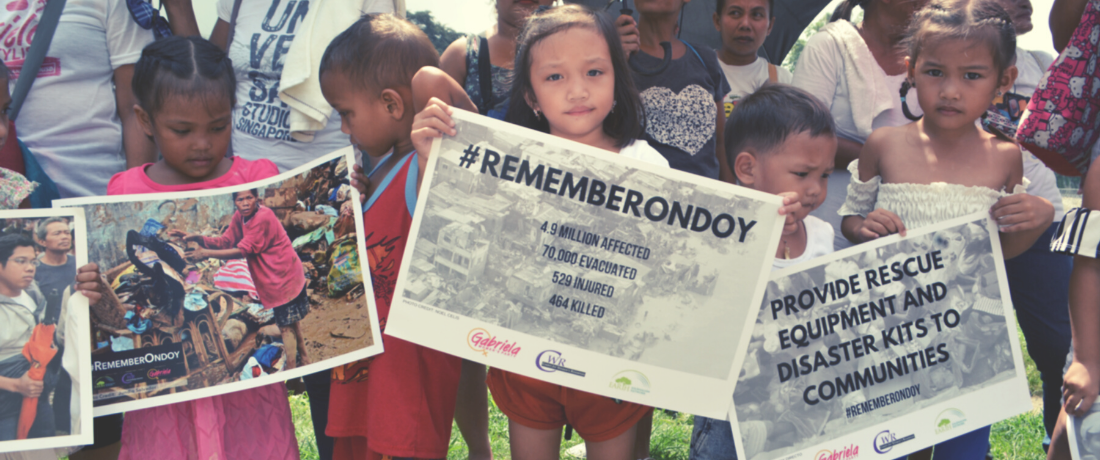
Survivors and their children gathered in Marikina to commemorate the 10th anniversary of Typhoon Ondoy.

KURO | Address poverty, jobs creation & price inflation, not Charter Change! Perception of Grassroots Women in Metro Manila on Marcos Jr. Administration’s Charter Change Center for Women’s Resources 2024
Charter Change, a priority legislation of the Marcos Jr. administration has been hotly debated in the Congress and the Senate in the last two years. To further understand the perceptions and opinions of female voters in Metro Manila about the issue, CWR conducted a survey in vote-rich communities in the region from June 15 to July 12, 2024.
The sample consisted of 897 female respondents aged 18 and above, representing the larger population of female voters in NCR. The data gathered also provided valuable insights for political campaigns and policy decisions leading up Marcos’ SONA in July 22 and upcoming 2025 elections in 2025.
Profile of Respondents
Age – Majority are between 35 and 44 years old and 45 and 54 years old, each having 20.4% representation. Those aged 25-34 years old come in second with 18.3%.
Civil Status – 47.3% are married, 18.5% are single, 16.6% are live-ins.
Work/Livelihood – 35.5% are self-employed or own-account workers, suggesting poor government efforts in providing jobs. This is alarmingly followed by 32.9% unemployed respondents. Only 7.2% are employed in formal establishments.
Monthly Household Income – Over 70% of the total respondents are minimum wage earners. Majority or 26.1% are low-income earners at P5,001 to P10,000 monthly, followed by 25.4% who earn less than P5,000 monthly, and 19.3% who earn P10,001 to P15,000 monthly.
Educational Level – 31.8% of the respondents are high school graduates. 23.4% reached high school and 12.9% at college level. Among the remaining respondents, 11% completed elementary, 9.4% reached elementary level and 6.1% completed college.
Survey Results
59.1% have heard of charter change
The remaining 363 respondents were not aware of the proposed charter change. This data contradicts the claims made by proponents of charter change that they have the support of the public, validating questions raised about the legitimacy of the People’s Initiative.
Only 14.5% of the respondents were able to give a brief description of charter change
Those who have heard but did not fully understand, and those who have little to no knowledge about charter change make up 44.4% of the sample when combined. This suggests that there is a need for more education and information dissemination to ensure that women are well-informed and able to participate in discussions and decision-making processes.
42.1% turn to conventional media as source of information
The number of respondents who rely on social media platforms for news comes in second at 6%, followed by information from neighbors or face-to-face interactions in their community at 4% and from local community groups or organizations with 1%.
49.7% do not know or cannot concretely explain how it might affect them and their families
Coming in second, 23% said that the constitutional change will only worsen their already poor economic conditions with the loss of jobs, lesser income, and higher prices of goods and utilities that it might entail. Only 3.6% said that charter change could potentially change their lives for the better.
Only 6.2% of the total respondents expressed agreement to charter change
A glaring 21.3% expressed that they do not agree with the proposed amendments in the Constitution, and 6.2% said they lack information to decide. Among those who responded that they agree, 26.0% said that Charter Change will bring about significant changes in people’s lives although they cannot articulate how charter change will bring about this. While 23.3% mentioned that Charter Change can bring about change in the system that will enable a strong economy. Out of the 303 respondents that articulated if they are in favor or not, 63% disagree, 18.5% agree, while 18.5% are undecided.
Those who oppose charter change believe that the government should instead prioritize issues that directly impact their lives.
These included addressing poverty and hunger (22.8%), job creation (20%), and controlling high prices of goods and services, including utilities (15.5%). Some (10.1%) expressed that support should be given to struggling sectors like healthcare, education, and housing. Additionally, the call for higher wages comes in as a top four concern (6.8%), reflecting the economic struggles faced by the majority of women.
Thematic Analysis / Findings
A. Awareness – The survey revealed overall that there seems to be a lack of clarity and understanding surrounding charter change among female voters in Metro Manila. Accessibility to information and education on the topic may be a contributing factor. Without a clear understanding of the implications, it may be difficult for individuals to form informed opinions and engage in meaningful dialogue on charter change.
B. On economic impacts – As revealed, almost half of the women in Metro Manila do not have any idea or cannot explain the potential effects of charter change in their lives. Combined with the perceived lack of understanding on the matter, a significant portion (23%) believes that the proposed amendment to the constitution will only worsen the economic conditions that most of them already experience – majority (70.8%) live below the poverty threshold set by the government, with many of them either self-employed and own-account workers (35.5%) who rely on “diskarte” due to scarce economic opportunities available or unemployed (32.9%).
C. On political impacts – Among the top reasons as to why women in Metro Manila disagree with charter change is because they believe that only the rich and those in power will benefit from such a move. 25.2% expressed concerns regarding impacts to democratic processes, political issues and governance. Some mentioned concerns on power abuse, against term extension, and lack of confidence in the current system of governance.
D. Priority – Rather than prioritizing charter change, the women of Metro Manila urged the government to focus on practical solutions that will have a direct and positive impact on the lives of the Filipino people like addressing poverty, joblessness and high prices. They also believe that charter change will only benefit the rich and those in power.