Yet again, ordinary Filipinos are directly bearing the impacts of fuel hikes. Everyday commuter including women would have to shell out more as a nationwide fare hike took effect yesterday, October 3.
Read moreStatements and Media Releases
Statements and media releases and statements from the Center for Women’s Resources
Statement on the 50th Anniversary of Martial Law
The Center for Women’s Resources joins the Filipino people in commemorating the 50th anniversary of the declaration of Martial Law, one of the darkest moments in Philippine history. Fifty years ago, Ferdinand Marcos Sr. plunged the country into an unsurmountable crisis characterized by massive plunder, corruption, elite rule, and political repression.
Read moreOn Pres. Marcos’ state visit to Indonesia, bring Mary Jane safely back home
The Center for Women’s Resources echoes the calls of the family, friends, and supporters of Mary Jane Veloso, to free her and bring her home to the Philippines. We call on President Marcos Jr. to prioritize raising the issue of Mary Jane Veloso and seek clemency as he visits and speaks with Indonesia President Joko Widodo this week.
Mary Jane Veloso, a Filipina migrant worker, has been unfairly languishing in jail for 12 years now. She was arrested in 2010 upon her arrival in Yogyakarta, Indonesia, when authorities found heroin hidden in the lining of the suitcase provided by her recruiters. She was convicted of illegally importing drugs and is currently on death row after a series of unfair trial proceedings.
Mary Jane previously worked as a domestic helper in Dubai to support her two young children. She fled after an attempted sexual assault. She went home, jobless and penniless. Despite the terrifying experience, she accepted when she was offered to work as a maid in Malaysia. But there was no job in Malaysia. Instead, she was told to travel to Indonesia, where she was given a suitcase lined with illegal drugs.
Mary Jane is among the many Filipinos, most of whom are women, who are forced to leave the country amid the chronic economic crisis and lack of job opportunities, only to become victims of human trafficking and subjects of extremely inhumane working conditions.
Mary Jane has suffered years of injustice as a woman and as a migrant worker. We reiterate our call for Pres. Marcos to urge Pres. Widodo to grant clemency and bring Mary Jane safely back home to her family. Moreover, we demand that the Philippine government ensure the safety and security of all Filipino migrant workers abroad.
Finally, we demand that the Marcos administration prioritize addressing the root cause of Filipino workers’ being compelled to take a chance on precarious opportunities overseas. By supporting rural development and national industrialization, it can provide decent jobs with living wages to its people and put an end to labor export.
CWR Statement on the International Day of Victims of Enforced Disappearances
The Center for Women’s Resources joins the families and friends of the disappeared, advocates and human rights defenders, in renewing the calls to end involuntary disappearance and human rights violations in the Philippines.
The abduction and disappearance of Elizabeth “Loi” Magbanua, Ma. Elena “Cha” Cortez Pampoza and Elgene Mungcal add to the long list of names of activists and community organizers who were forcibly taken and disappeared. Data from human rights organization Karapatan showed that there had been 254 victims of enforced disappearances in the Philippines — from the Arroyo administration up to July 2021 during the Duterte administration.
Last May 3, Loi Magbanua, a labor organizer and women’s rights advocate, was abducted along with fellow labor organizer, Alipio “Ador” Juat. A few days later, Ador communicated with his family, informing them that unidentified men abducted and forced them into separate vehicles. The two are believed to be detained against their will in a military camp.
On July 3, peasant organizers and human rights defenders Cha Pampoza and Elgene Mungcal went missing in Moncada, Tarlac. Before her disappearance, Cha’s family had been subjected to harassment by uniformed personnel of AFP and PNP.
We urge the public to express support for the families and friends of victims of enforced disappearances and other human rights violations, especially with the widespread climate of impunity. The impunity enjoyed by perpetrators of enforced disappearances and extrajudicial arrest and detention is exacerbated by Duterte’s Executive Order 70 – the ‘whole of nation approach’ that intensifies brutal attacks towards activists and human rights advocates. It is high time to raise our voices and speak out against these rights violations and demand justice.
Finally, we challenge the Marcos administration to show its sincerity in addressing the spate of involuntary disappearances and human rights violations in the country by revoking Duterte’s EO 70, dismantling the NTF-ELCAC, and promptly ratifying the International Convention for the Protection of All Persons from Enforced Disappearance.
Statement of Support for HB 2173 – Security of Tenure Bill
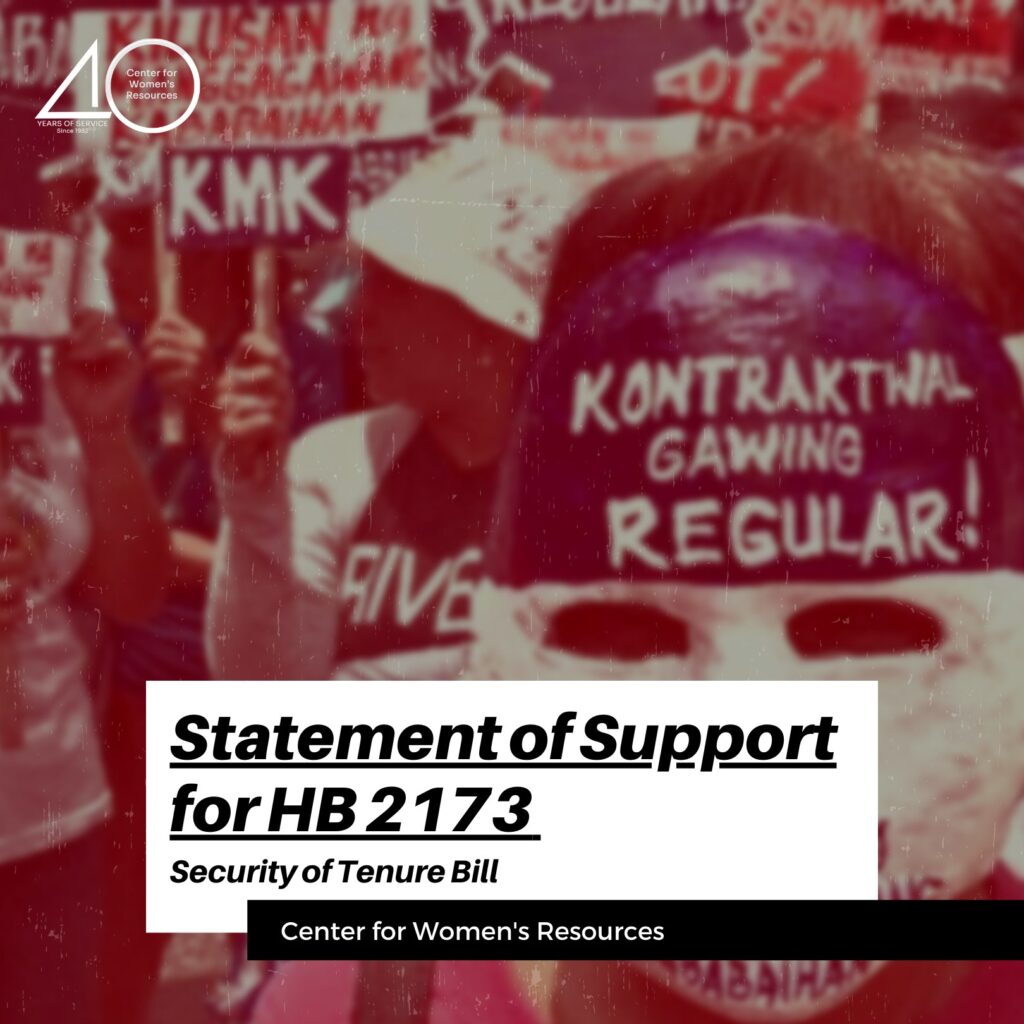
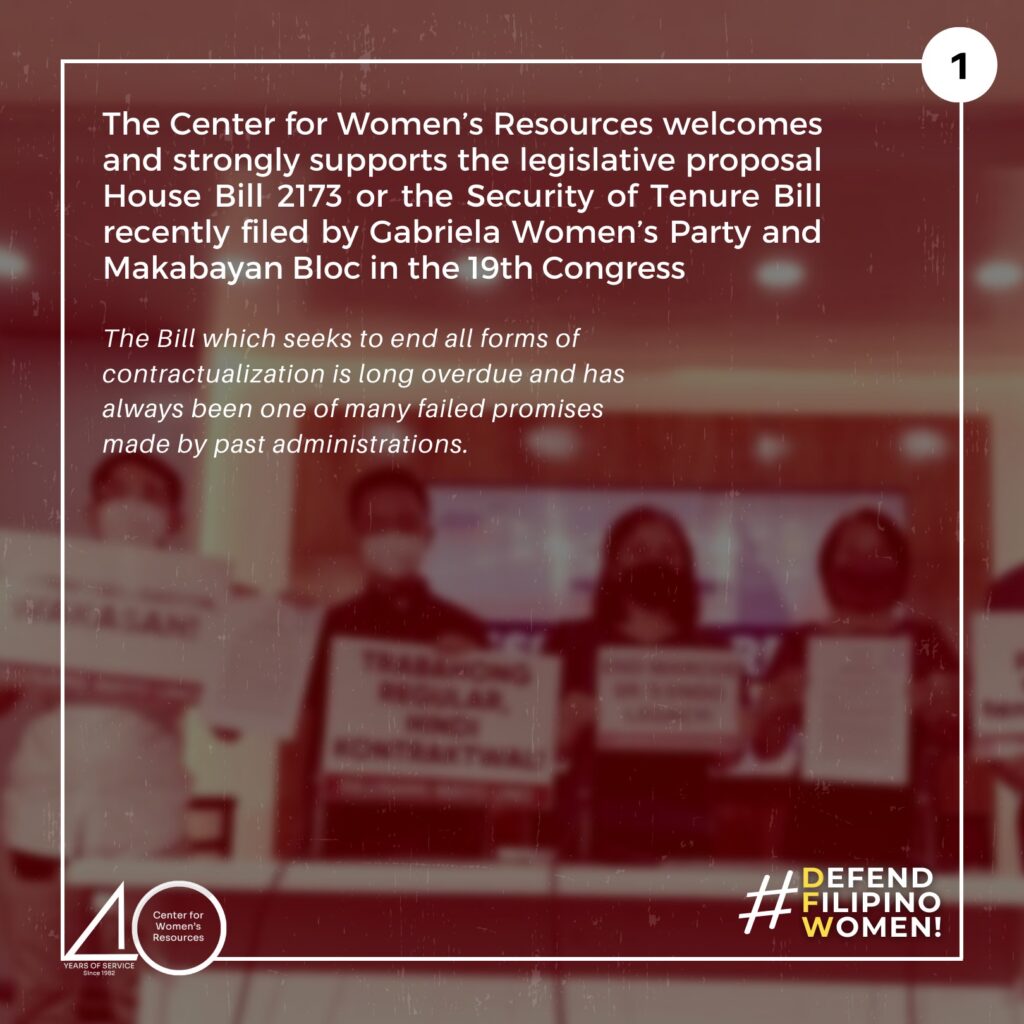
The Center for Women’s Resources (CWR) welcomes and strongly supports the legislative proposal House Bill 2173 or the Security of Tenure Bill recently filed by Gabriela Women’s Party and Makabayan Bloc in the 19th Congress. The Bill which seeks to end all forms of contractualization is long overdue and has always been one of many failed promises made by past administrations.
With the current pandemic situation, high unemployment rate, the dwindling income of Filipino families, rising prices of consumer goods, and concerning increases in poverty and inequality, CWR believes that Congress and this administration must immediately pass legislation to protect and advance workers’ rights.
Even before the pandemic, Filipino women workers are found in precarious labor and 60% are considered economically insecure. With the economic contraction brought by the pandemic, workers under contract were pushed to further insecure conditions as they were the first to lose their jobs. They live at a critical point, vulnerable, and often with no buffer against economic shocks.
CWR, in its recent study on the conditions of women workers amid the pandemic found the following:
1. Contractual workers have fewer employee benefits like company medical insurance, and this forces employees/workers to pay out-of-pocket for expenses that under normal circumstances are covered by an employer. Although the government mandated employers to pay for certain benefits such as SSS, Philhealth and PAG-IBIG for all types of workers, some employers do not pay for these benefits. Other benefits that contract workers do not receive compared to regular workers include paid vacation/ sick leave, and 13th month pay.
2. Contract workers need to provide for their own retirement plans and savings for periods of unemployment.
3. “No work, no pay” rule imposed on employees by service contracts and contract workers.
4. Low wages are a disadvantage for employees who are hired on a flexible basis. Workers in these arrangements are much more likely to earn wages that are at or near the minimum wage and earn significantly less than regular workers. As a result, many of these workers are working at/or near the poverty level.
5. Contractualization undermines worker’s right to organize and form unions.
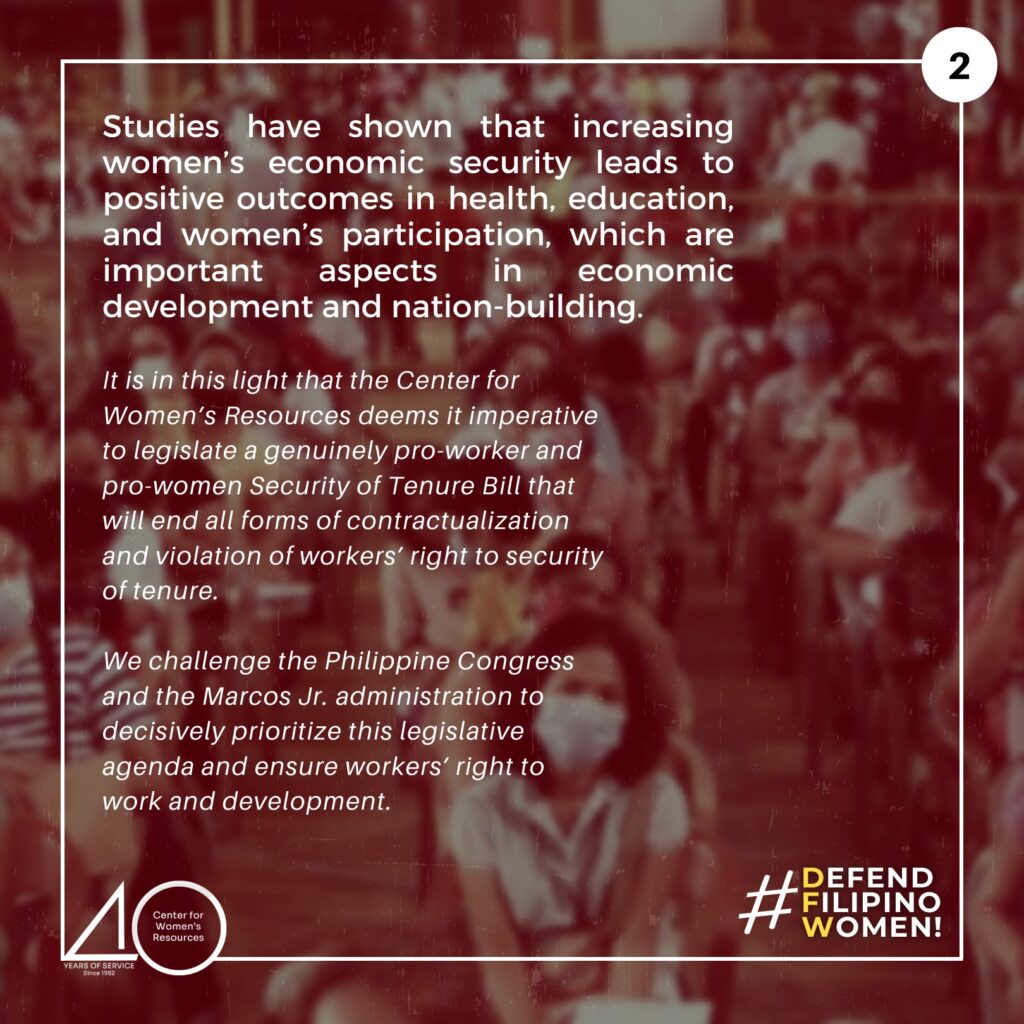
The road to pandemic recovery presents an important opportunity to reverse the trend of disadvantaged workers through enacting the Security of Tenure Bill. Further, many studies have shown that increasing women’s economic security leads to positive outcomes in health, education, and women’s participation, which are important aspects in economic development and nation-building.
It is in this light that the Center for Women’s Resources deems it imperative to legislate a genuinely pro-worker and pro-women Security of Tenure Bill that will end all forms of contractualization and violation of workers’ right to security of tenure. We challenge the Philippine Congress and the Marcos Jr. administration to decisively prioritize this legislative agenda and ensure workers’ right to work and development.