Oppose Villavert’s promotion, stand for human rights and civil liberties

The Center for Women’s Resources (CWR) expresses its fervent opposition to Quezon City Executive Judge Cecilyn Burgos-Villavert’s application for promotion as Associate Justice of the Court of Appeals (CA), Associate Justice of the Sandiganbayan, and Ombudsman Special Prosecutor. Villavert’s history of issuing questionable search and arrest warrants against activists and women human rights defenders undermines justice and threatens civil liberties.

With the help of state forces, under the direction of former president Rodrigo Duterte, Villavert’s dubious warrants led to illegal arrests and detention of 76 activists from 2018 to 2020, according to human rights group Karapatan. Among the most controversial cases for which Villavert is accountable are the “Human Rights 7”, where activists were slapped with trumped-up charges, and the “Bloody Sunday” operation that killed nine activists in Calabarzon.

Villavert also issued the warrant that led to the arrest of Reina Mae Nasino, who was pregnant at the time, in 2019. Nasino gave birth to her daughter, Baby River, at the Manila City Jail during the pandemic. Shortly after filing an urgent motion for furlough, Baby River died.

Journalist Lady Ann Salem was also arrested through one of Villavert’s warrants. Like in Nasino’s case, courts also voided the warrants issued and cleared her of her charges.

Women’s rights activist Cora Agovida was among those whose homes were raided by the police in 2019 through a Villavert-issued search warrant. The Manila court later acquitted Agovida of the trumped-up charges filed against them by state forces.

Given Villavert’s track record of transgressions and incompetence, there is no question that if she were given higher positions in the judiciary, she would undoubtedly use this power and authority to further sow terror and injustice in a country where there is already rampant corruption and blatant disregard for human rights.

CWR calls upon the Judicial and Bar Council (JBC) to heed the appeals of human rights defenders, peace advocates, and their families by rejecting Villavert’s application for promotion and initiating thorough investigations into judges who routinely issue unjustified warrants. CWR implores all Filipinos to stand united and vigilant against all measures and actions that aim to suppress people’s resistance by violating human rights and civil liberties. #

Women’s group condemns Marcos admin’s negligence amidst El Niño crisis

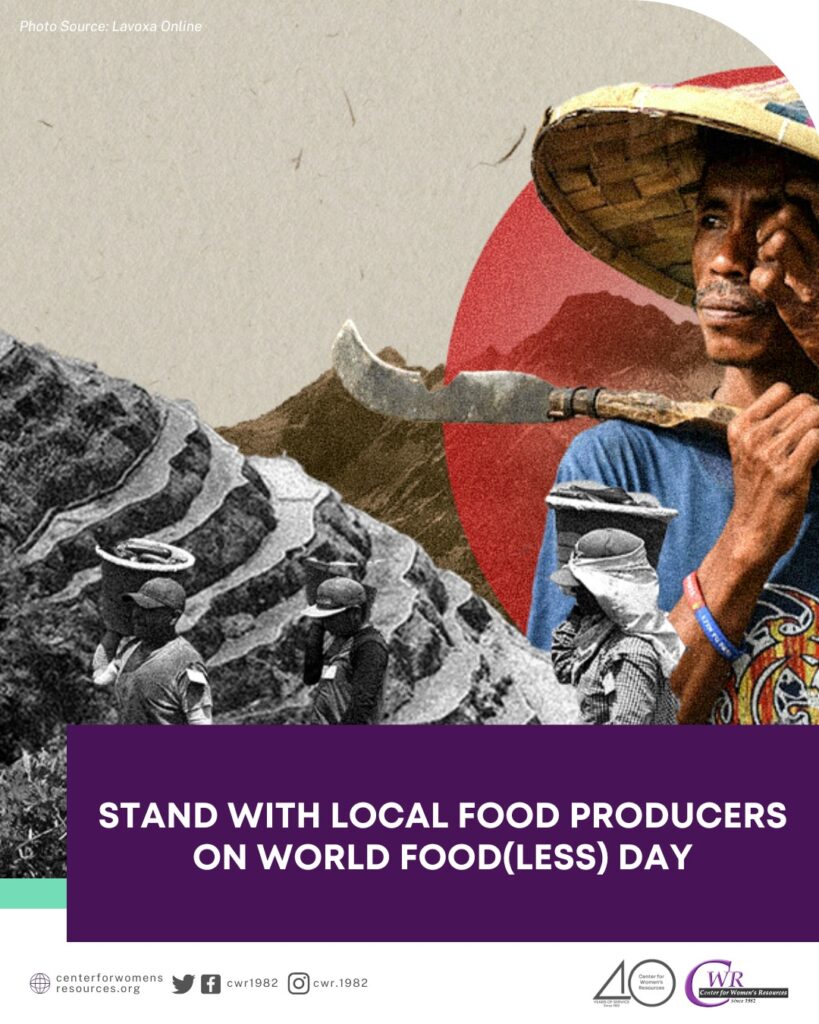
The Center for Women’s Resources (CWR) condemns the negligent response of the Marcos administration to the devastating impacts of El Niño, particularly on peasant women. The administration’s failure to address the needs of peasant communities underscores a pattern of disregard for the welfare of those most vulnerable to environmental and economic crises.

The impact of El Niño on the agricultural sector in the Philippines has been devastating, with over 41 provinces experiencing severe consequences, including the loss of farmlands and crops. As of March 2024, the damage to agriculture amounts to P1 billion, with a significant loss in rice production alone. Around 247,610 farmers and fisher folk are also at risk of bankruptcy and loss of livelihood.

Despite these alarming figures, President Marcos Jr.’s response has been dismissive and insensitive as he refused to declare a nationwide state of calamity. Even before the impacts of El Niño, the poverty incidence among farmers and fisher folk is already alarmingly high. In 2021, the poverty incidence among farmers was at 30% and 30.6% among fisher folk, the highest among sectors. According to the PSA, the agriculture and fisheries sector comprised 10.8 million in 2022, where 2.99 million are women.

The root of the crisis lies in the failure to prioritize the development of local agriculture to the detriment of the livelihood of Filipino farmers. For instance, neoliberal policy of privatization led to monopolization of water resources and distribution that left small-scale farmers at the mercy of private players such as Ayala’s Manila Water, Maynilad of Metro Pacific Investments, and Prime Water of Villar Group. Consequently, only 1.2% or 39,300 hectares of irrigation development target has been reached despite the increased budget allocation to the National Irrigation Administration (NIA) in the national budget.

Trade agreements and laws like the Agriculture and Fisheries Modernization Act (AFMA), World Trade Organization Agreement on Agriculture (WTO-AoA), Rice Liberalization Law, and Regional Comprehensive Economic Partnership (RCEP) have favored foreign interests over national development which hinders the growth of the agricultural sector. The push for the pro-foreign ownership “economic” Charter Change further threatens the agricultural sector.

As El Niño subsides and the threat of La Niña looms, the government’s inaction in providing adequate support and resources to mitigate the effects of extreme weather patterns is alarming. Without proper assistance and planning, farmers will continue to face significant challenges and losses due to unpredictable weather conditions and climate change. Coupled with a trend of silencing dissent through militarization and violence, it poses a grave threat to the safety and well-being of farmers, fisher folk, and land rights activists.

The Center for Women’s Resources stands firmly in solidarity with Filipino farmers amidst this ongoing crisis. We echo their demand for urgent government support and an end to neoliberal policies that exacerbate the plight of Filipino farmers. We urge all Filipinos to unite in demanding that the government prioritize the well-being of its citizens, to safeguard our rights to livelihood and democratic rights. #

Filipino women’s conditions plummet under Marcos Jr. false hopes, empty promises

Pioneer women’s research institution Center for Women’s Resources opens women’s month with biannual Ulat Lila report on the national situation of Filipino women, March 1, 2024.

“In Marcos Jr.’s second year, while still reeling from the impacts of the pandemic, women are faced with even deeper crises – from unemployment and loss of livelihoods, to declining incomes and rising prices of goods and services. Meanwhile, the profits of foreign and local businesses benefiting from the priority programs of the current administration in infrastructure and trade continue to grow.” – Cham Perez, CWR Executive Director.

In its report, CWR notes how the majority of women experience severe crises and remain part of the most impoverished sectors of society. Perez also mentioned how the worsening poverty faced by Filipino people, including women, is primarily attributed to the scarcity of job opportunities and livelihood with decent wages and adequate income.

Between November 2022 and November 2023, 17.3 million women or 55.4% of women aged 15 years and above were not counted in the labor force.

Meanwhile rural women continue to suffer hunger and sink deeper into debt. Five years into the implementation of the Rice Liberalization Law, rural women endure livelihood losses, hunger and grappling with escalating debt burdens. The absence of sufficient subsidies and assistance forces women farmers to turn to micro-lending institutions to cope with soaring farm input expenses. Particularly in Southern Mindanao, women confront mounting debt as farm input expenses soar and product prices plummet, resulting in minimal or no income from production.

The women’s group is also alarmed by the Marcos Jr administration’s push for Charter Change that will further open the country to foreign investment and possible increase in foreign military presence. “Historically, foreign investments did not automatically translate to jobs and livelihood with decent wages and incomes for Filipino women,” added Perez.

CWR’s report also highlighted that during severe crises, women and children endure heightened abuse and exploitation, especially those from impoverished backgrounds who are particularly vulnerable. According to PNP-CIRAS, there were 19,635 reported cases of violence against women and children (VAWC) from January to August 2023, averaging 92 victims per day during this period. The lack of state support, access to public services and state negligence further exacerbate this abuse.

“Moreover, cases of abuse committed by soldiers and police officers continue. These include the rape cases reported by residents in Negros Occidental, Davao City, and in Cebu. While often dismissed as isolated cases, this is a clear exercise of power and impunity. If law enforcers are perpetrators themselves, where else can victims report cases to? In addition, what is more alarming is the number of cases that were unreported due to fear and lack of access to resources and infrastructures to protect victims,” added Perez.

Amidst the crisis and the people’s resistance, the Marcos Jr. administration continues to intensify repression in both urban or rural areas, targeting members of organized unions, community associations, development workers and women human rights defenders.

“Only two years into the Marcos Jr.’s administration, there have been 23 women political detainees. From July 2022 to June 2023, there were already 8 women victims of political extrajudicial killings,” Perez notes.

The report argues that Marcos Jr. administration uses the same playbook used by predecessors and late dictator father. Laws and government institutions are used as instruments to suppress women and people’s movements. Red-tagging, harassment, surveillance, and various forms of attacks against anyone standing up for their democratic rights remain rampant.

“As long as the crisis persists and the dominant neoliberal system serves the interests of the few while the majority suffer, women will stand united with the toiling masses in their struggle for a just and equitable society. Their continuing assertion and resistance is the most potent and sustainable means to achieve structural transformation,” Perez concludes. #

On UN SR Irene Khan’s visit, women’s institution highlights the protection of Filipino women’s right to freedom of opinion and expression

The Center for Women’s Resources welcomes the visit of UN Special Rapporteur Irene Khan to the Philippines. CWR recognizes this as an opportunity to emphasize the need to protect and uphold the right to freedom of opinion and expression for Filipino people, especially of marginalized women and women human rights defenders. These fundamental rights serve as cornerstones in the advancement of women’s development and the safeguarding of women’s human rights within democratic societies.

In the Philippines, women who speak up face significant risks. Even voicing demands for jobs, livelihood, access and control over land and other resources, access to health and education services, can lead to persecution. These women are attacked and harassed for being members and leaders of organizations, associations, and unions that oppose state’s anti-people policies and actions. They face constant surveillance, arbitrary arrests, and unfair trials, all aimed at silencing their voices and undermining their work.

Restrictive laws such as the Anti-Terror Law (ATL), the creation of NTF-ELCAC and the continuing implementation of Executive Order 70 enables and exacerbates the risks faced by women human rights defenders. This stark reality persists despite international and national commitments, including recommendations under the UPR, CEDAW, and SDGs. 

In a span of one year, from July 2022 to June 2023, eight (8) women, mostly peasant and rights activists, have fallen victims to political extrajudicial killing. Three women have been forcefully disappeared, including peasant rights advocates Elgene Mungcal and Ma. Elena Pampoza. Illegal arrest on trumped up charges also continues. 

According to Karapatan, in July 2022, 13 human rights defenders in the Southern Tagalog region were slapped with charges under the ATL. This includes a 19-year-old woman, Hailey Pecayo, coordinator and paralegal of Tanggol Batangan. Pecayo joined a fact-finding mission to look into the killing of 9-year-old Kyllene Casao by suspected military elements in Taysan, Batangas. Also facing charges under ATL is Jasmin Rubio, secretary-general of Mothers and Children for the Protection of Human Rights. 

It is crucial to note that these women human rights defenders are leaders in their respective communities, they are farmers, workers, indigenous people, who have long experienced discrimination and rights violations, and thus know and hold the solution to the current economic and social crisis that we are facing. As key stakeholders, WHRDs are uniquely positioned to advocate for solutions that will ensure women’s democratic rights. 

In time for UN SR Irene Khan’s visit to the Philippines, we demand urgent attention and action to address the challenges faced by WHRDs and ensure that women’s voices are not silenced:

1. Address the culture of impunity surrounding attacks on women human rights defenders. Investigate and prosecute perpetrators to ensure accountability and justice.

2. Repeal repressive laws such as the Anti-Terror Law (ATL) that curtail freedom of opinion and expression. Steps must be taken to ensure freedom to hold opinions without interference and to seek, receive and impart information and ideas through any media, and regardless of frontiers, as stipulated in the Universal Declaration of Human Rights. Ensure that laws and policies align with international human rights standards and do not hinder the work of women human rights defenders.

3. Implement comprehensive mechanisms to protect women human rights defenders. Foster an environment that encourages open dialogue and inclusivity, ensuring that women’s voices, particularly those of marginalized groups, are heard and valued in decision-making processes.

As we strive for a society that upholds democracy and justice, we call on the Philippine government to take concrete steps to respect, protect, and promote women’s democratic rights. We hope that UN Special Rapporteur Irene Khan will hear the voices of marginalized sectors and women’s human rights defenders. We hope that she will incorporate their perspectives into her report, which should serve as the foundation for formulating recommendations to strengthen the protection of human rights in the Philippines.

Finally, we call on all Filipino people to remain steadfast in our commitment to pursuing our democratic rights. It is through our collective unity and shared struggles that we can guarantee its realization towards a just and democratic society. #

After 37 years of Mendiola Massacre, justice remains elusive, struggle for land distribution continue

Justice remains elusive almost four decades after the bloody dispersal in Mendiola where 13 farmers, including peasant woman Adelfa Aribe, were killed and 50 others injured on January 22, 1987. Thousands of farmers and peasant rights advocates marched towards the Malacañang Palace demanding for free land distribution and living wage in the midst of massive landlessness and poverty.

Years on, in the face of persistent adversity, farmers and advocates for peasant rights march on. Vast tracts of land remain disproportionately concentrated in the hands of a select few landlords or under the dominion of agro-corporations and plantations. This protracted struggle has given rise to a new generation of farmers and activists, committed to demanding free land distribution, adequate funds for agricultural subsidies, and facilities.

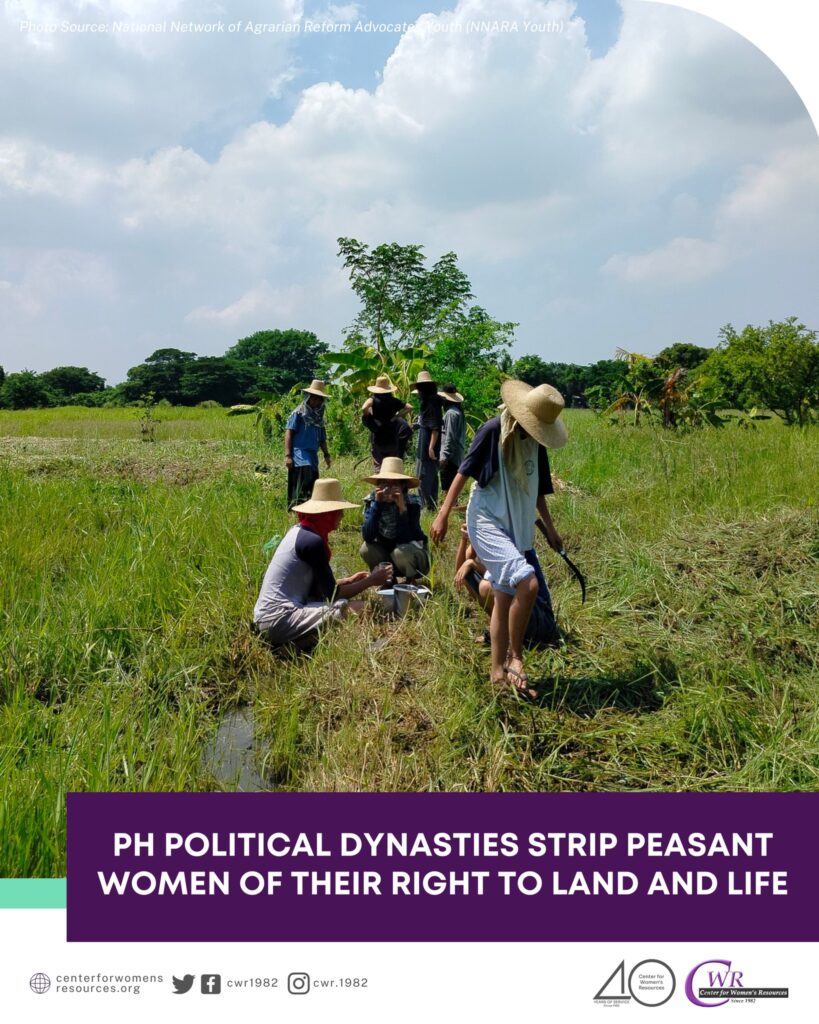
Farmers including peasant women continue to organize themselves and reclaim their access and control over land and resources through different means. Alarmingly, these actions were met with violence by state forces, private goons of landlord-politicians, and through intensified militarization in rural areas.

Attacks against peasant advocates particularly intensified during the Duterte administration, with a long list of women farmers and peasant advocates killed by state forces. This includes Elisa Badayos, who was killed in 2017 in Negros; farmer Leonila Pesadilla, who donated a parcel of their land to a Lumad (indigenous) school; and Cora Lina, an active member of United Farmers in Laak in Compostela Valley. 

Rights violations against peasant women continued during the Marcos Jr. administration, from illegal arrest and detention to extrajudicial killings, including the enforced disappearances of peasant and land rights advocates Ma. Elena “Cha” Pampoza and Elgene “Leleng” Mungcal in Central Luzon.

Despite the pervasive attacks, peasant women remain steadfast and militant. They actively participate in the struggle for emancipation, presenting alternatives and taking action to address hunger and poverty. Those who were left with no other recourse, have chosen to confront guns with guns, joining revolutionary groups in the pursuit of land and justice.

In remembrance of the victims of the Mendiola Massacre, the Center for Women’s Resources (CWR) stands united with peasant women and rights advocates in resolutely demanding land to the tillers and echoing the enduring call for justice. #