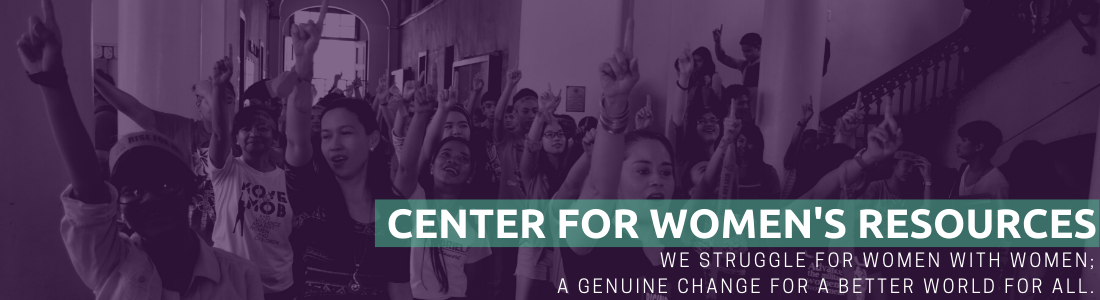
As regional leaders prepare to gather for the 49th Association of Southeast Asian Nations (ASEAN) Summit alongside US President Donald Trump, the Center for Women’s Resources (CWR) said that the worsening conditions of women across Southeast Asia expose the limits of an economic and political agenda that prioritizes profits, foreign interests, and military alliances over people’s welfare.
Across the region, women remain concentrated in low-wage and insecure work. Rural and indigenous women face land dispossession and the destruction of their livelihoods due to extractive industries and development projects. Migrant women workers are still trafficked, discriminated against and exploited in the labor market. Women in conflict-affected communities are the ones who suffer most from militarization and armed violence.
In the Philippines, these inequalities directly affect the poorest sectors– women, children, farmers, fisherfolks, and indigenous peoples. According to official poverty statistics in 2025, 8.66 million women belong to poor families, second only to 9.29 million children. That same year, farmers posted the third highest poverty incidence at 27%, following fisherfolks (27.4%), and indigenous peoples (32.4%).
These conditions are inseparable from the political and economic direction of the country. Trade and investment policies that privilege corporations, weak protection for workers, dependence on foreign markets, and expanding military commitments do little to address poverty, unemployment, violence and the destruction of women’s livelihoods. Instead, women are left to absorb the consequences through low-paid work, unpaid care responsibilities, economic insecurity, and inadequate access to essential services.
“Filipino women cannot eat economic growth statistics, nor can they find security in military agreements that fail to address poverty, unemployment, violence, and the destruction of their livelihoods. What women need are decent jobs, living wages, accessible public services, social protection, genuine land reform, and an economy that serves the needs of the people,” says CWR Executive Director Cham Perez.
CWR calls on the Marcos Jr. administration and other ASEAN governments to place people’s needs at the center of regional cooperation. This requires genuine national industrialization, agrarian reform, protection of workers’ rights and livelihoods, accessible public services, social protection, and stronger measures to address violence against women. It also requires rejecting policies such as the Enhanced Defense Cooperation Agreement (EDCA) or Visiting Forces Agreement (VFA) that deepen military dependence and undermine national sovereignty.
For CWR, ASEAN’s success should not be measured by the volume of trade agreements, foreign investments, or military partnerships it secures, but by whether women and marginalized communities can live with dignity, security, and freedom from exploitation.