The Center for Women’s Resources (CWR) asserted that the World Bank’s reclassification of the Philippines as an upper middle-income country (UMIC) should not be interpreted as proof that the lives of Filipino women have substantially improved.
According to CWR, the World Bank’s income classification is based primarily on gross national income (GNI) per capita—an average income measure that fails to capture income inequality, poverty, labor conditions, or women’s economic realities.
CWR contends that despite the country’s higher income classification, millions of Filipino women continue to face low wages, insecure and informal employment, rising living costs, and limited access to quality public services. The organization argues that the designation creates an illusion of development while overlooking the structural inequalities that persist in Philippine society.
“The problem with relying on an average income measure is that averages conceal inequality,” CWR Executive Director Cham Perez explained. “The enormous wealth accumulated by a handful of billionaires raises the country’s average income, but this does not mean that ordinary workers are earning more or living better.”
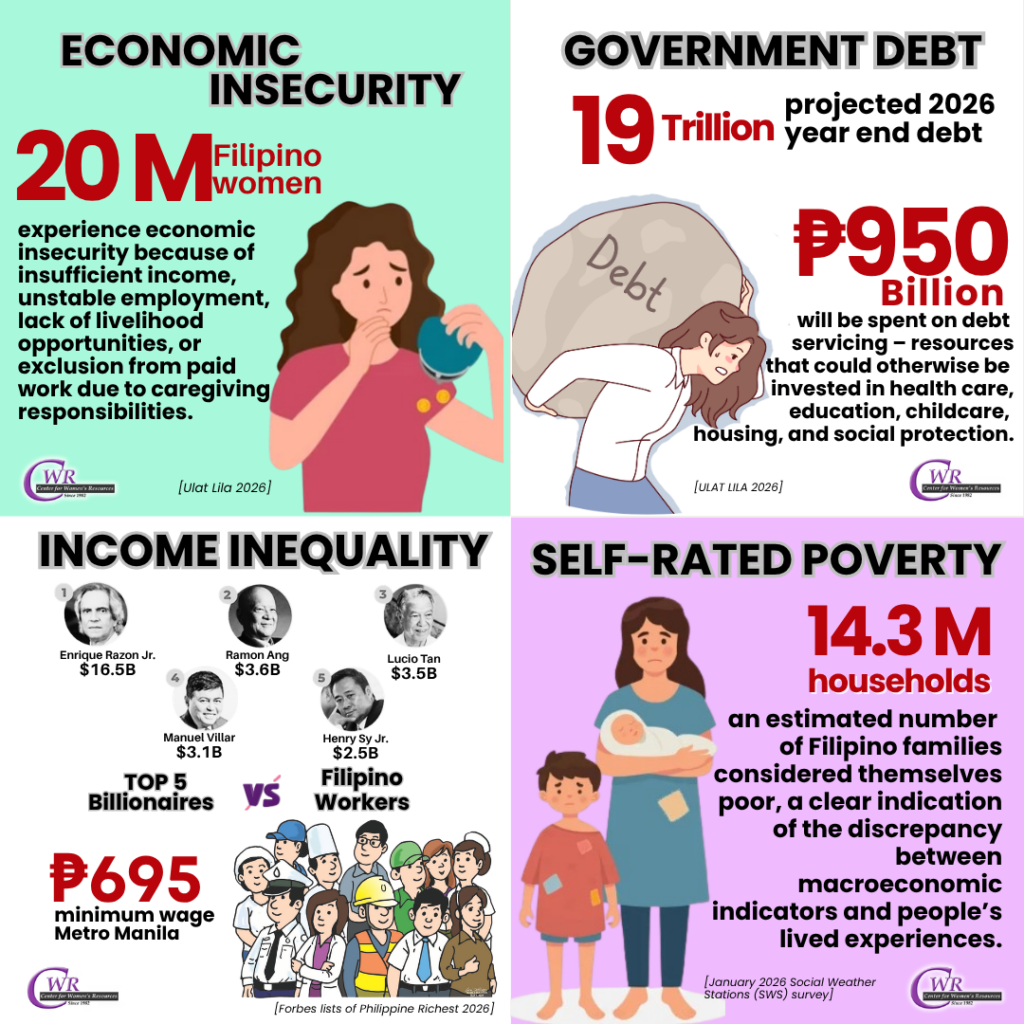
Perez noted that the disparity between the country’s wealthiest individuals and ordinary workers illustrates the limitations of income-based classifications. While billionaires like Enrique Razon and Ramon Ang have amassed fortunes worth billions of dollars, millions of Filipino workers continue to survive on wages that barely cover the cost of daily necessities. A minimum wage earner in Metro Manila receiving ₱695 a day remains worlds apart from the country’s wealthiest business elites, yet both are reflected in the same national average used to determine the country’s income classification.
CWR said this disconnect is reflected across multiple social and economic indicators.
Women’s labor force participation remains only 52.3% compared with 75.2% for men, indicating that millions of women continue to face barriers to paid employment. Among those who are employed, many remain concentrated in low-paying and precarious occupations, including domestic work, vending, home-based work, gig work, and export-oriented manufacturing, where contractualization, low wages, and limited social protection remain widespread.
CWR estimates that well over 20 million Filipino women continue to experience economic insecurity because of insufficient income, unstable employment, lack of livelihood opportunities, or exclusion from paid work due to caregiving responsibilities.
CWR also questioned the government’s employment statistics, noting that anyone who worked for at least an hour during the reference week is officially counted as employed. While employment rates may appear favorable on paper, they often conceal the realities of underemployment, irregular work, and wages that remain insufficient to meet a family’s basic needs.
“The real condition of workers cannot be measured simply by employment figures,” Perez said. “Having a job does not mean having a decent livelihood. Millions of Filipinos are working but remain poor because their wages are too low, their jobs are insecure, or they cannot find enough hours of work.”
These realities are reflected in people’s own assessment of their living conditions. The January 2026 Social Weather Stations (SWS) survey showed that 51% of Filipino families, or an estimated 14.3 million households, consider themselves poor, a clear indication of the discrepancy between macroeconomic indicators and people’s lived experiences.
Women also continue to face persistent wage inequality. The gender wage gap is largest in occupations where women are highly concentrated, at 26.2% for service and sales workers and 29.4% for workers in elementary occupations, demonstrating how occupational segregation continues to depress women’s earnings.
These conditions are rooted in decades of neoliberal policies that prioritize foreign investment, trade liberalization, deregulation, and privatization over building domestic industries and modernizing agriculture, according to CWR. The organization noted that the same international financial institutions that now classify the Philippines as an upper middle-income country have long promoted these policies through development lending and policy prescriptions.
“Instead of building a strong domestic industrial base and a productive agricultural sector, these policies have encouraged greater dependence on foreign investment, imports, labor export, and cheap Filipino labor,” Perez said. “The result has been an economy that generates wealth for corporations and a small elite while leaving millions of workers – especially women – in precarious employment, low-paying jobs, and economic insecurity.”
Perez also warned that the country’s upgraded income status comes amid a growing public debt burden. Outstanding national government debt reached ₱17.71 trillion by the end of 2025 and is projected to approach ₱19 trillion by the end of 2026. This year alone, approximately ₱950 billion will be spent on debt servicing – resources that could otherwise be invested in health care, education, childcare, housing, and social protection.
CWR further cautioned that, as an upper middle-income country, the Philippines may gradually lose access to concessional financing, potentially increasing borrowing costs without addressing the structural causes of poverty and inequality.
“Development cannot be measured simply by crossing an income threshold,” Perez said. “The real question is whether economic growth has translated into secure livelihoods, living wages, affordable food, quality education, accessible health care, and a life of dignity for Filipino women and their families.”
Rather than celebrating a statistical milestone, CWR called on the Marcos Jr. administration to pursue a development strategy anchored in national industrialization, genuine agrarian reform, living wages, strengthened labor rights, universal social protection, expanded public care services, and gender-responsive public investments. The organization also urged the government to adopt a more progressive fiscal system that ensures those with the greatest wealth contribute a greater share toward financing public services.
“Women should not be asked to measure progress through economic statistics that fail to reflect their everyday realities,” Perez concluded. “Real development occurs only when women are free from poverty, have decent and secure jobs, receive equal pay for equal work, and enjoy access to quality public services.”